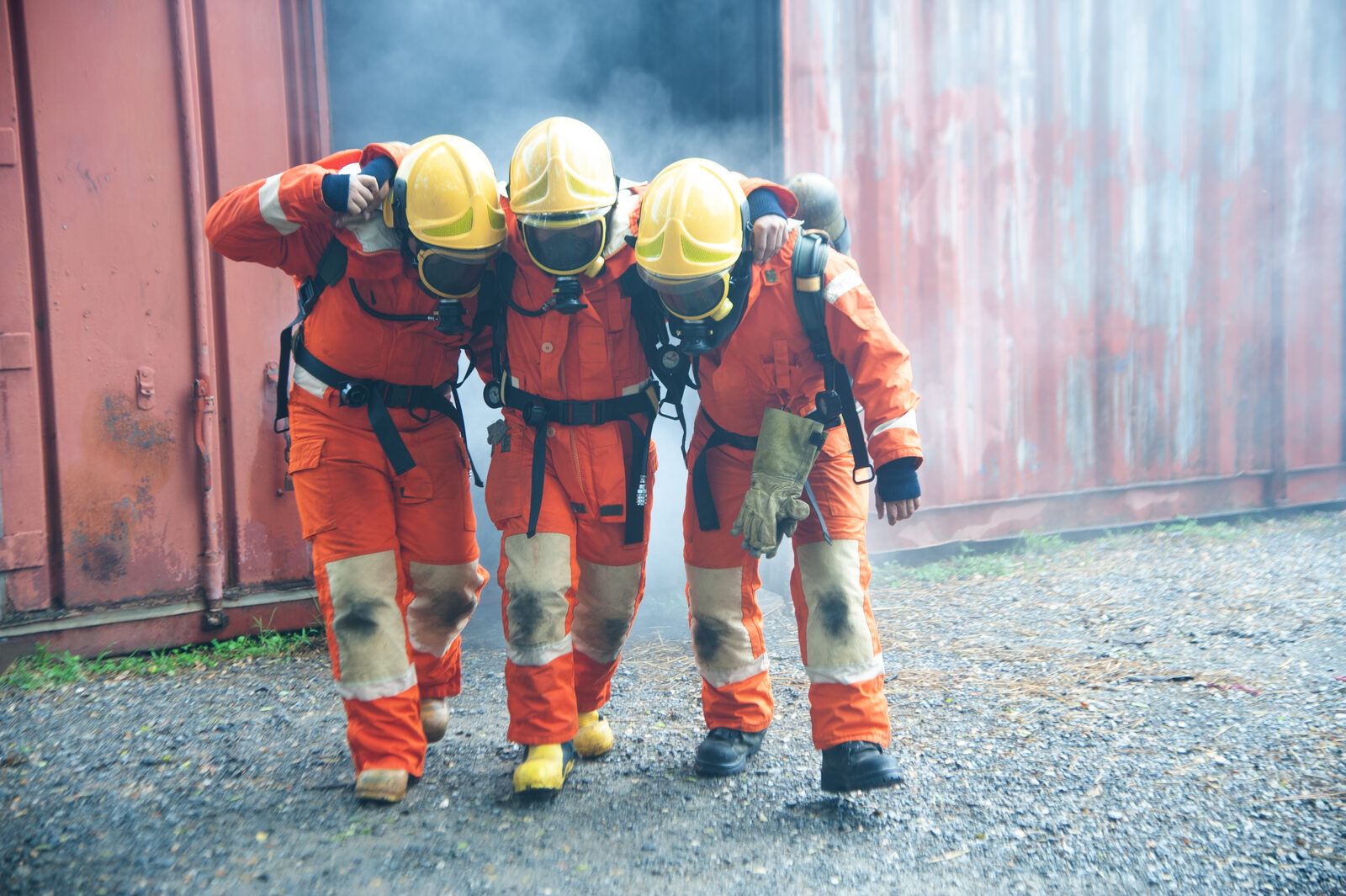
Why People Fail the CPAT (It's Usually the Stair Climb)
The CPAT fails fit people. Gym-strong candidates walk in confident and walk out stunned, because the test doesn't measure what gyms train: it measures three minutes of loaded stepping followed by seven grip-hungry work intervals with no rest except walking. Understand where attempts actually die and most of the fix is obvious.
If you haven't seen the course yet, start with the full event-by-event breakdown — this guide assumes the layout and goes straight at the failure points. For the conditioning build-up that prevents them, see the 12-week CPAT training plan.
Where attempts actually die
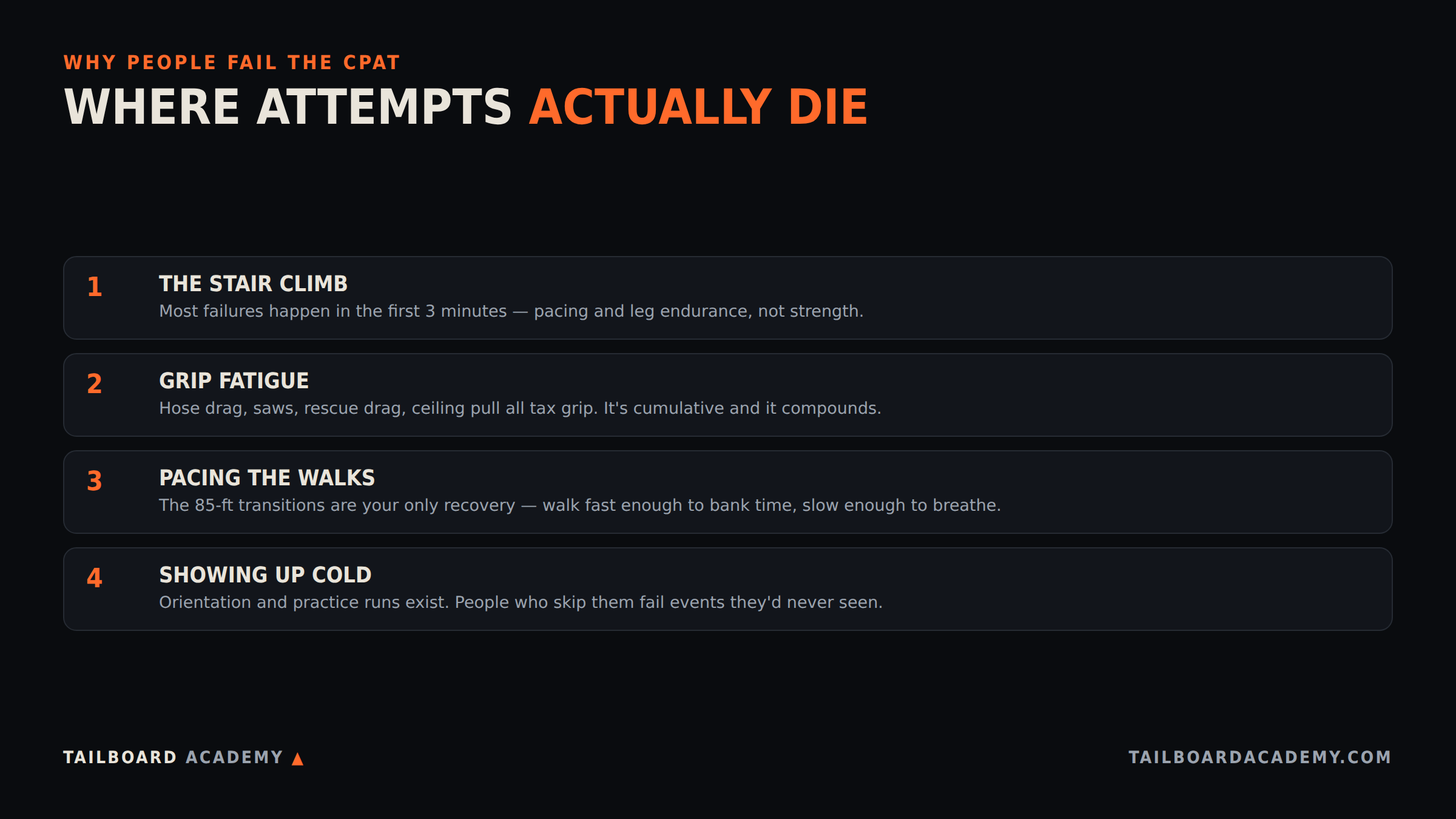
The stair climb, first and worst. Three minutes at 60 steps per minute carrying 75 pounds, as event one. Failures here are total — step off the StepMill after the start and the attempt is over — and near-failures are nearly as costly, because a candidate who survives the climb at redline has mortgaged the seven events that follow. The gym stair machine lies to you: it lets you support weight on the rails, which the test forbids. Unracked, loaded, hands-free stepping is a different exercise, and the first time you try it should not be test day.
Grip, cumulatively. No single event destroys grip; the sequence does. Hose drag, saw carry, ladder halyard, sledge, rescue drag, pike pole — by the ceiling breach, forearms are the limiting system for almost everyone. Candidates who "suddenly" can't hold the pike pole in event eight actually lost that event back in event two; they just didn't feel it yet.
Pacing the transitions. The 85-foot walks between events are the only recovery on the course. Stroll them and the 10:20 math stops working around event six; sprint-walk them all and you arrive at the rescue drag — the most anaerobic event — with nothing. Passing comfortably means treating the whole course as one paced 10-minute effort.
Showing up cold. Licensed CPAT centers run orientations and timed practice runs. The search tunnel, the StepMill cadence, the mannequin's awkwardness — every one of these is survivable with exposure and alarming without it. Skipping the practice run to "save the trip" is how prepared people fail unprepared.
The stair climb, specifically
It earns its own section because it's where the largest share of attempts is decided, and because almost everything candidates believe about it before test day is wrong.
What the event actually is. A 20-second warm-up on the StepMill at 50 steps per minute, then — with no break in the clock — three minutes at a fixed 60 steps per minute, carrying 75 pounds total: the 50-pound vest plus two 12.5-pound shoulder weights simulating a hose bundle. The extra 25 pounds comes off at the end of the event. Your heart rate does not.
The machine sets the pace, and that's the trap. Every stair machine you've trained on let you choose your speed and back off when it got ugly. The StepMill does not. Three minutes is a long time at a cadence you didn't pick, and there is no version of "pushing through" that helps — you cannot bank time, because the event has a fixed duration rather than a target. Effort buys you nothing here; efficiency buys you everything.
The rails are not available to you. On the warm-up you may steady yourself. Once the test clock is running, using the rails or the wall for support draws a warning, and repeated contact or stepping off the machine ends the attempt outright. This is the single biggest reason gym training misleads people: most of us unconsciously carry ten or fifteen percent of our weight through our hands on a stair machine and have no idea we're doing it. Take your hands off for one session and the event becomes a different exercise. Confirm the exact warning-and-failure rules with the site you'll test through, since administration varies.
The failure is usually downstream. Very few people fall off the StepMill. What happens instead is that they finish the climb at redline, spend the transition walk trying to get their breathing back, and never do — and then the hose drag and equipment carry, which are not hard events, become impossible ones. When someone tells you they failed on the equipment carry, they usually failed on the stair climb three minutes earlier.
How to know if you're ready. Hold 60 steps per minute for three continuous minutes, in a vest, hands entirely off the rails, and be able to hold a conversation within about ninety seconds of stepping off. If you can do that, the climb is not going to be what fails you. If you can't, it's the first thing to fix — and it's the most trainable thing on the whole course.
What to do about it
Each of the four failure points above has a straightforward remedy, and none of them is a secret: unracked loaded stair work with your hands off, grip endurance trained at the end of sessions rather than the start, deliberate pacing practice on the transitions, and a booked orientation or practice run before the real thing.
Sequencing them across a calendar is the part that actually takes planning — that's laid out phase by phase in the 12-week CPAT training plan, including a compressed version if your test date is closer than that.
Knowing the events is step one. Training for them is the rest. Tailboard builds a CPAT or Biddle plan around your current fitness and the date you actually test.
After the card
Here's the strategic note candidates miss while staring at the CPAT: it's pass/fail. Passing earns you exactly zero rank. The event that decides where you land on the hiring list is the oral board — and unlike the CPAT, it has no licensed practice course in your county. That asymmetry is why I built Tailboard Academy's Oral Board Simulator: unlimited scored rehearsals with three voiced panelists and written after-actions, so the event that actually ranks you gets at least as many reps as the one that doesn't. And once you've got a badge date, the same physical base rolls straight into academy prep.
FAQ
What percentage of people fail the CPAT?
Published pass rates vary widely by site and by how much orientation candidates attend — centers consistently report that practice-run attendance is the strongest predictor of passing. Plan on being someone who practiced, and the population statistics stop mattering.
Can I retake the CPAT if I fail?
Yes — retake policies and fees vary by testing center, and many allow retesting after a waiting period. But a retest costs you weeks in a hiring cycle, and hiring cycles don't wait. Preparing properly the first time is cheaper than being right about that later.
Is the stair climb really 75 pounds?
Yes — the standard 50-pound vest plus two 12.5-pound shoulder weights, removed after the climb. It's the only event at 75; the rest run at 50.
Why is the CPAT stair climb so hard?
Three things stack: it's the heaviest load on the course, the machine sets a fixed 60-steps-per-minute cadence you can't back off from, and you can't use the rails for support once the clock starts. Most gym stair-machine training quietly violates all three, so candidates arrive believing they've trained the event when they've trained something considerably easier.
How do I train for the CPAT stair climb?
Loaded, unracked, hands-off stepping — a weighted vest on real stairs or a StepMill, building toward three continuous minutes at 60 steps per minute without touching the rails. Start well under 50 pounds and add weight over weeks, not sessions. Train the recovery too: the climb doesn't fail people, the events immediately after it do.
I'm strong but small — am I at a disadvantage?
The events are the same for everyone, and technique closes most size gaps: the ladder raise, sledge, and mannequin drag all reward mechanics over mass. Small candidates who train grip and pacing pass routinely.
How close to test day should my last hard session be?
Keep the final simulation about 7–10 days out, then taper to light movement. Arriving fresh matters more than one more brutal week.
The CPAT ranks nobody. The oral board ranks everybody. Give the board the reps it deserves — Tailboard Academy's Oral Board Simulator, three voiced panelists, live follow-ups, written after-actions. Built by a working SoCal firefighter/paramedic. Run a free board — no card.
By John — active Southern California firefighter/paramedic. He went through this hiring process himself and built Tailboard Academy's Oral Board Simulator: three voiced panelists, live follow-up questions, and a written after-action after every session.