Fire Academy Prep: What to Do in the 8 Weeks Before Day One
You got the call, you passed everything, and there's an academy start date on your calendar. Congratulations — now hear the uncomfortable truth every recruit training officer repeats: academies don't primarily wash people out on ability. They wash people out on arrival condition — recruits who show up under-conditioned, behind on the academic load, or with a home life that couldn't absorb sixteen weeks of stress. All three are fixable in the eight weeks before day one.
What the academy actually demands
Whether it's a 16-week municipal academy or a longer regional program, the shape is consistent: physical training most mornings, drill-ground evolutions in full turnouts and SCBA regardless of weather, a genuine academic load — hydraulics math, fire behavior, building construction, protocols — with tests you can fail out on, and a paramilitary structure where being two minutes early is late and details (uniforms, gig lines, gear readiness) are the curriculum. The recruits who thrive treat it as a job with homework; the ones who struggle treated the start date as the finish line.
The 8-week plan
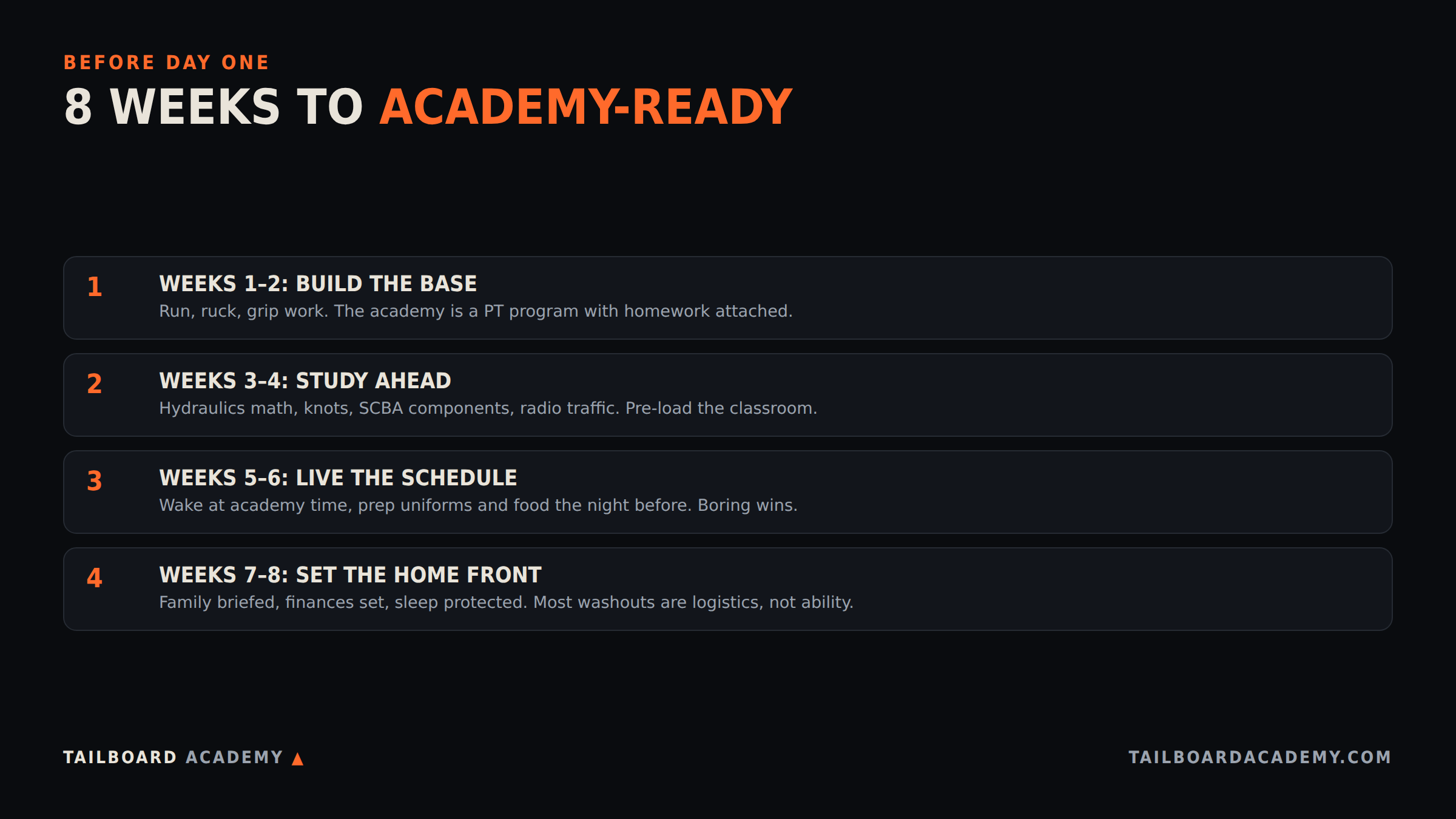
Weeks 1–2 — Build the base. The academy PT standard isn't a max lift; it's repeatable daily work capacity. Run (build toward 3 comfortable miles), ruck with a 40–50 pound pack, and hit grip and pulling work hard — hose, ladders, and tools are grip all day. If your CPAT training has lapsed since testing, this is where it resumes; the same loaded-stair and carry work transfers directly.
Weeks 3–4 — Study ahead. Get the academy's textbook list (usually IFSTA Essentials or equivalent) and pre-read the chapters that generate early tests: fire behavior, PPE/SCBA, building construction. Drill friction-loss and pump math until basic hydraulics feels like arithmetic, not algebra. Learn your knots — figure eight family, clove hitch, bowline — with rope in hand while watching TV. Every hour banked now is an hour of sleep saved in week three of the academy, which is when sleep gets scarce.
Weeks 5–6 — Live the schedule. Shift your alarm to academy wake-up time now — 0430 on day one should be your fortieth 0430, not your first. Prep uniforms and food the night before as standing practice. Heat-acclimate if your academy runs summer evolutions: work outside in layers, hydrate like it's your job, because it's about to be. Boring discipline, deliberately rehearsed, is the entire skill.
Weeks 7–8 — Set the home front. Most washouts are logistics, not ability. Brief your family honestly: sixteen weeks of early mornings, late studying, exhausted weekends, and a version of you with a shorter fuse. Pre-solve childcare, money, and commute contingencies. Build your study system before you need it — a fixed evening block, flashcards, a classmate group from orientation day. Then taper the physical work in the final week; arrive rested, not wrecked.
Reading about the oral board is step one. Sitting one is the rest. Tailboard runs a live panel that asks real follow-ups and scores you like a real board. Run one free, no card.
Small things that read big on day one
Show up early, squared away, with everything on the required list and nothing extra. Learn names fast — instructors and classmates. Volunteer first, especially for the unglamorous jobs; RTOs notice who reaches for the broom. When corrected, the answer is "yes sir/ma'am, correcting it" — not context, not explanation. And protect sleep like a certification: the academy is a sixteen-week test of whether you can perform tired without becoming careless.
One more that outlasts the academy: keep your interview sharp. Probation includes evaluations, and many departments run promotional and station assignments through panel formats for your whole career. The habit of speaking in structured, out-loud answers — the one you built with board rehearsal — doesn't retire when you badge; it becomes how you brief, how you teach, and eventually how you promote.
FAQ
How fit do I need to be for the fire academy? Comfortably above the CPAT standard, sustained daily. A useful benchmark: 3 miles running without distress, an hour of loaded work (vest or ruck) without collapse, and grip that survives a day of ladders and hose. Build repeatability, not maxes.
What's the hardest part of the academy? Ask graduates and the answer is rarely one evolution — it's the accumulation: PT plus academics plus inspection standards plus fatigue, for weeks. Which is exactly why pre-loading academics and pre-living the schedule pays more than any single workout.
Can you fail out of a fire academy? Yes — academically (failed exams), physically (can't complete evolutions safely), or behaviorally (integrity and attitude). Departments invest in getting you through, but the standards are real.
Should I buy my own gear beforehand? Only what the academy's official list requires. Showing up with unrequested tactical extras reads exactly how you'd guess. Spend the money on good boots if permitted — feet are the first casualty of academy life.
Is the academy paid? At most career departments, yes — you're a hired probationary employee. Pre-service or college academies you fund yourself. Confirm your situation early because it changes your eight-week financial prep.
You rehearsed your way into the academy. Keep the habit. Tailboard Academy's Oral Board Simulator stays useful from first interview to promotional panels — three voiced panelists, live follow-ups, written after-actions. Built by a working SoCal firefighter/paramedic. Run a free board — no card.
By John — active Southern California firefighter/paramedic. He went through this hiring process himself and built Tailboard Academy's Oral Board Simulator: three voiced panelists, live follow-up questions, and a written after-action after every session.