How to Become a Firefighter in California: The Real Steps and the Real Timeline
California hires more firefighters than any state in the country — and has the candidate pools to match. The process isn't a mystery, but it is a pipeline: certifications, statewide testing, department-by-department hiring lists, and an academy at the end, typically spanning 12 to 24 months from first decision to first shift. Here's the whole road, in order, with the places Southern California candidates specifically gain or lose ground.
Before anything: the baseline requirements
Most California departments require you to be 18 (some 21 for firefighter/paramedic roles), hold a valid California driver's license, and have a high school diploma or GED. Nearly all require EMT certification by hire date — and as a practical matter, having it before you apply is the de facto standard, because it signals you're serious and most academies presume it. A felony record isn't an automatic bar everywhere, but honesty about your history is non-negotiable once background starts.
The pipeline
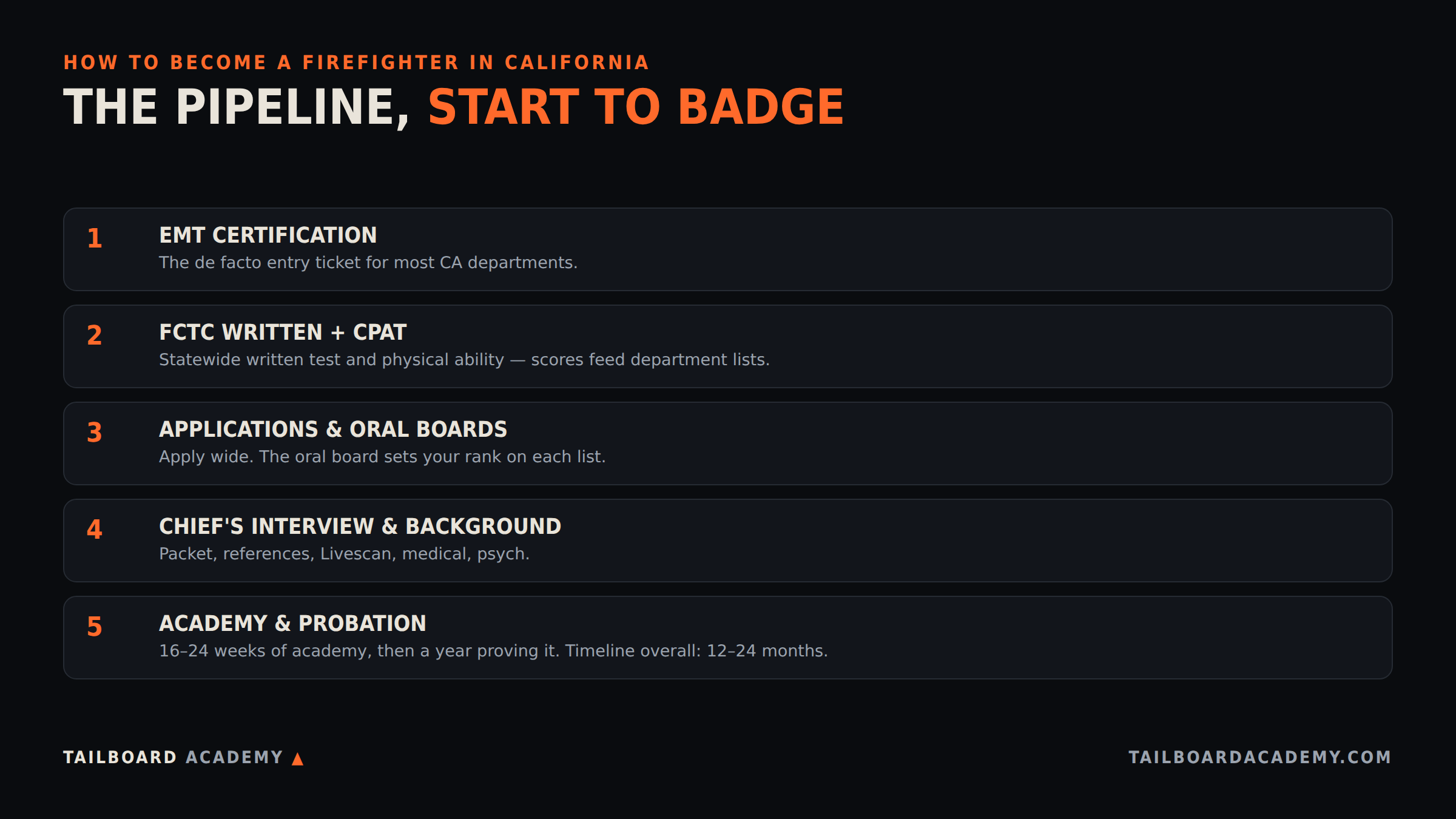
Step 1 — EMT certification (3–6 months). An accredited EMT course, the NREMT exam, then California state certification through a local EMS agency. If you're deciding whether to go paramedic first, read do you need to be an EMT first — the short version is EMT now, medic strategically.
Step 2 — FCTC written test and CPAT. Much of California hiring runs through the Firefighter Candidate Testing Center (FCTC), operated under CAL-JAC: a statewide written test and the CPAT physical ability test, with your results feeding a statewide eligibility list many departments pull from. Some agencies use National Testing Network or their own exams instead — read each posting. The written is covered in our written exam guide; the physical in the CPAT breakdown, with the conditioning build-up in the CPAT training plan.
Step 3 — Applications and oral boards. This is the stage that actually ranks you. Apply wide — LA County, LA City, Orange County, San Diego, CAL FIRE, and dozens of municipal departments run separate processes on separate calendars, and testing with many in parallel is how the median successful candidate does it. Each department's oral board sets your position on their list; prepare with the 25 questions you'll actually get.
Step 4 — Chief's interview, background, medical, psych (2–4 months). Conditional offers trigger the long gate: personal history statement, Livescan, references, medical exam, psychological evaluation. Nothing here should surprise a candidate who's been honest since step one.
Step 5 — Academy and probation. Municipal academies run roughly 16–24 weeks; CAL FIRE's basic training is shorter but seasonal employment often precedes permanent slots. Then probation — about a year of proving it daily.
California-specific angles worth knowing
CAL FIRE is a different door. Seasonal firefighter positions (especially with prior wildland experience or a Fire Fighter 1 academy) can start a career while you test for municipal jobs — many SoCal firefighters ran both tracks at once. Fire technology units and academies help but don't replace testing. A community-college FF1 academy strengthens applications and some departments require it pre-hire; it doesn't skip the pipeline. Paramedic is the biggest single lever. Departments like Orange County hire firefighter/paramedics preferentially, and a medic license can cut years off your wait — at the cost of 12–18 months of school. The bottleneck is the board. With statewide testing centralizing writtens and CPATs, most SoCal candidates arrive at oral boards with identical paperwork — the interview is where the list order actually gets decided.
That last point shaped my own path through this process, and it's why Tailboard Academy leads with the oral board: three voiced panelists, live follow-ups, and a written after-action, built so a California candidate can rehearse the one stage that separates them from an otherwise identical field.
Reading about the oral board is step one. Sitting one is the rest. Tailboard runs a live panel that asks real follow-ups and scores you like a real board. Run one free, no card.
The honest planning numbers
Budget 12–24 months from "I'm doing this" to a badge, and treat the spread as mostly yours to compress: certs on your schedule, test dates on the state's, list timing on each department's. The full month-by-month math is in how long it takes to become a firefighter. Plan finances for the academy months especially — some departments pay you through academy; pre-service academies you fund yourself.
FAQ
Do I need a college degree to be a firefighter in California? No. A high school diploma or GED meets most minimums. Fire technology units help applications and promotions later, but EMT certification and strong testing matter far more at entry.
Is the FCTC test required everywhere in California? No — many departments use FCTC's statewide list, others use National Testing Network or in-house exams. Check each department's job posting; serious candidates usually end up taking more than one written.
How competitive is it, really? Hundreds of applicants per opening at popular municipal departments is normal. The candidates who get hired treat it as a numbers-and-preparation game: many applications, many lists, and a top-band oral board every time.
Should I go CAL FIRE seasonal first? If you can: real fireground experience, a paycheck in the industry, and a résumé line every panel respects. It's not required, and municipal testing can run in parallel.
What disqualifies you in California? Varies by department, but recent DUIs, undisclosed criminal history, and dishonesty during background are the recurring killers. Disclosure survives almost everything; concealment survives nothing — details in our background guide.
In California, the paperwork looks the same — the board is where you separate. Rehearse it with Tailboard Academy's Oral Board Simulator: three voiced panelists, live follow-ups, written after-actions. Built by an active SoCal firefighter/paramedic. Run a free board — no card.
By John — active Southern California firefighter/paramedic. He went through this hiring process himself and built Tailboard Academy's Oral Board Simulator: three voiced panelists, live follow-up questions, and a written after-action after every session.