How to Practice for the EMT, Paramedic & Firefighter Exams
Taking practice tests is not one activity. There are four distinct kinds, they answer different questions, and using the wrong one at the wrong time is why people grind through hundreds of questions without their score moving. This is how each one works and when to reach for it.
Most practice tests hand you a score and a list of wrong answers. Tailboard Academy is built to do more: full-length, category-scored practice for the firefighter entry written exam, the EMT exam, and the Paramedic (NREMT-style) exam, scored the moment you finish, with written feedback that tells you exactly what to fix. The guides on this site are free to read, and a sample test is open to everyone.
_Independent educational resource. Tailboard Academy is not affiliated with or endorsed by the NREMT, the National Testing Network, FCTC, or any fire department or testing agency. Practice questions are original study material, not actual exam content. No exam, certification, or employment outcome is guaranteed._
What you can practice
| Track | What it covers |
|---|---|
| Firefighter entry written | Reading comprehension, math, mechanical reasoning, spatial orientation, and situational judgment: the kind of cognitive-aptitude content used on NTN/FCTC-style entry exams. |
| EMT | NREMT-style, EMT-scope questions across airway/respiration, cardiology & resuscitation, trauma, medical & OB/GYN, and EMS operations. |
| Paramedic (NREMT-style) | Paramedic-level questions across all the same domains, at the depth the National Registry actually tests. |
Every track carries hundreds of questions, and every question is taught, with a full rationale explaining why the right answer is right and why each distractor is wrong, plus a working-medic field note where it helps. You're building understanding, not memorizing an answer key.
How the practice works
A Baseline Diagnostic. 50 questions, one untimed sitting, stratified to the official NREMT test plan: a complete map of every domain on day one, and again at midterm to measure the gain.
Weekly Checks. 20-question, category-scored tests you can finish in about 15 minutes. Take one a week and you always know exactly where you stand and what to drill first.
A Readiness Check (adaptive). For EMT and Paramedic, a short check on the same computer-adaptive engine as the real exam: harder when you're right, easier when you're not, ending the moment your level is clear, usually 10–25 questions in about 15 minutes.
Exam Day, a full Registry simulation. The real exam's actual format: computer-adaptive, drawn to the official NREMT test-plan weights, no going back, no feedback until the end. EMT runs 70–120 questions on a 2-hour clock; Paramedic runs 110–150 questions on a 3.5-hour clock, the same shapes as the real exams. The first time you feel that shouldn't be at the testing center. (The firefighter entry track keeps a 100-question timed simulator, because that exam really is a linear timed test.)
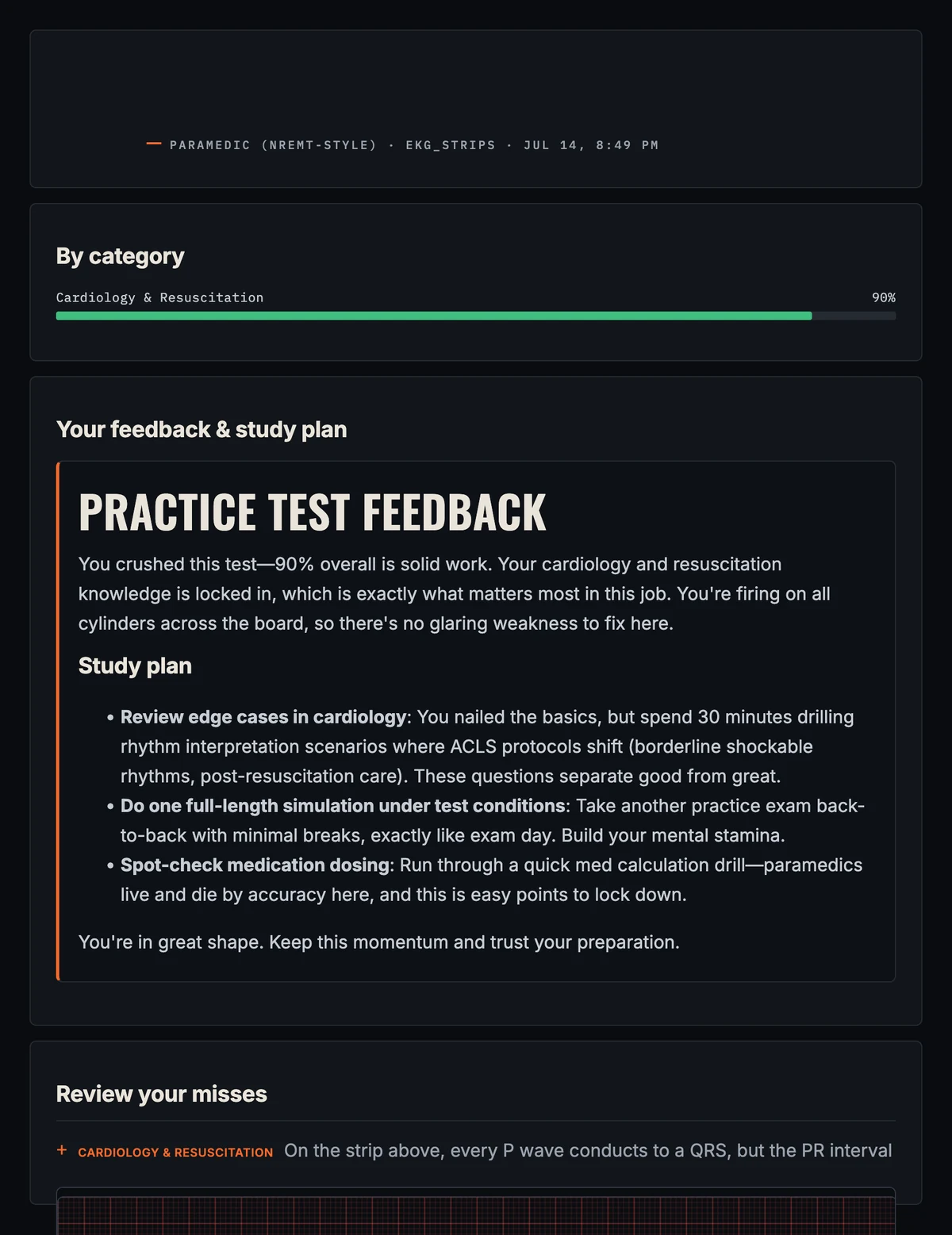
Written feedback and an AI tutor. Every attempt is analyzed, and the AI tutor can generate unlimited fresh questions on your weakest categories with full explanations, tracking your improvement over time. A static question bank can't do that.
Why "taught, not just scored" matters
A score tells you that you're weak in a category. A rationale tells you why you missed the question: the distinction between two look-alike answers, the protocol detail you skipped, the trap the item was built around. That's what actually moves your score, and it's the difference between practice that builds knowledge and practice that just measures it.
Reading about the written is step one. Sitting one under a clock is the rest. Tailboard scores full-length practice by category, so you find out which section is costing you the points.
Run a free scored test, no card → Take the 20-question check first
Beyond the written test
Getting hired is not one exam. It is a pipeline. Alongside the practice tests, Tailboard trains the parts that decide jobs: Oral Board Simulator rounds you can answer out loud and get scored on, branching clinical scenario sims, a full EKG rhythm tool, pharmacology flashcards, med-math and radio-report drills, and CPAT/Biddle fitness plans, plus straight-talk hiring guides, all in one place.
Frequently asked questions
Are the practice tests free?
The hiring guides are free to read with no account, and a sample test is open to everyone. Full access to the complete question banks and tools is a one-time $59 90-Day Hiring Season Pass (about one full hiring cycle), or $24.99/month with a 7-day free trial, or $179/year.
Are these real NREMT questions?
No. All questions are original study material written to mirror the format and domains of the exams. They are not actual exam content, and Tailboard is not affiliated with the NREMT or any testing agency.
What's the difference between the Readiness Check and Exam Day?
Same adaptive engine, two jobs. The Readiness Check is the weekly pulse: 10–25 questions, about 15 minutes, untimed, ends the moment your level is clear. Exam Day is the dress rehearsal: the real Registry exam's full format: EMT 70–120 questions in 2 hours, Paramedic 110–150 in 3.5 hours, adaptive, no back-navigation, no feedback until the end. Check weekly; simulate Exam Day two or three weeks out and once more before your window.
Do the practice tests guarantee I'll pass?
No, and no honest prep tool can. They're built to help you prepare and to show you exactly what to fix, but no exam or hiring outcome is guaranteed.
How many practice questions are there?
Hundreds per track (firefighter entry, EMT, and Paramedic), and the AI tutor generates unlimited additional fresh questions on your weak areas.