
How Firefighter Oral Boards Are Scored: Rubrics, Dimensions, and What Raters Write Down
While you're answering question three, the people across the table are writing. Knowing what they're writing is the difference between practicing blind and practicing on target. The short version: raters score each answer against a fixed set of dimensions — typically communication, motivation and preparation, judgment, integrity, and interpersonal skills — on a numeric scale, and your combined score sets your position on the eligibility list.
None of this is secret. Many agencies publish their criteria, California's joint apprenticeship committee (CAL-JAC) circulates sample oral interview material, and civil-service rules in most states require boards to score all candidates against the same standard. This guide assembles what's publicly known — plus what I learned preparing for and going through these boards myself as a candidate — into a picture you can train against.
Why boards use rubrics at all
Entry-level firefighter hiring in most jurisdictions runs under civil-service or merit rules: every candidate gets the same questions, and raters must be able to defend the scores they hand out. That constraint shapes everything you experience in the room. It's why panels read questions from a script and rarely banter, why your answer to a question you've prepared for still gets probed the same way as everyone else's, and why a structured answer beats a charming one — structure maps cleanly onto a scoresheet; charm doesn't.
It also means the board is more predictable than it feels. Raters aren't hunting for brilliance. They're hunting for evidence they can point to in each scored category.
What's on the scoresheet
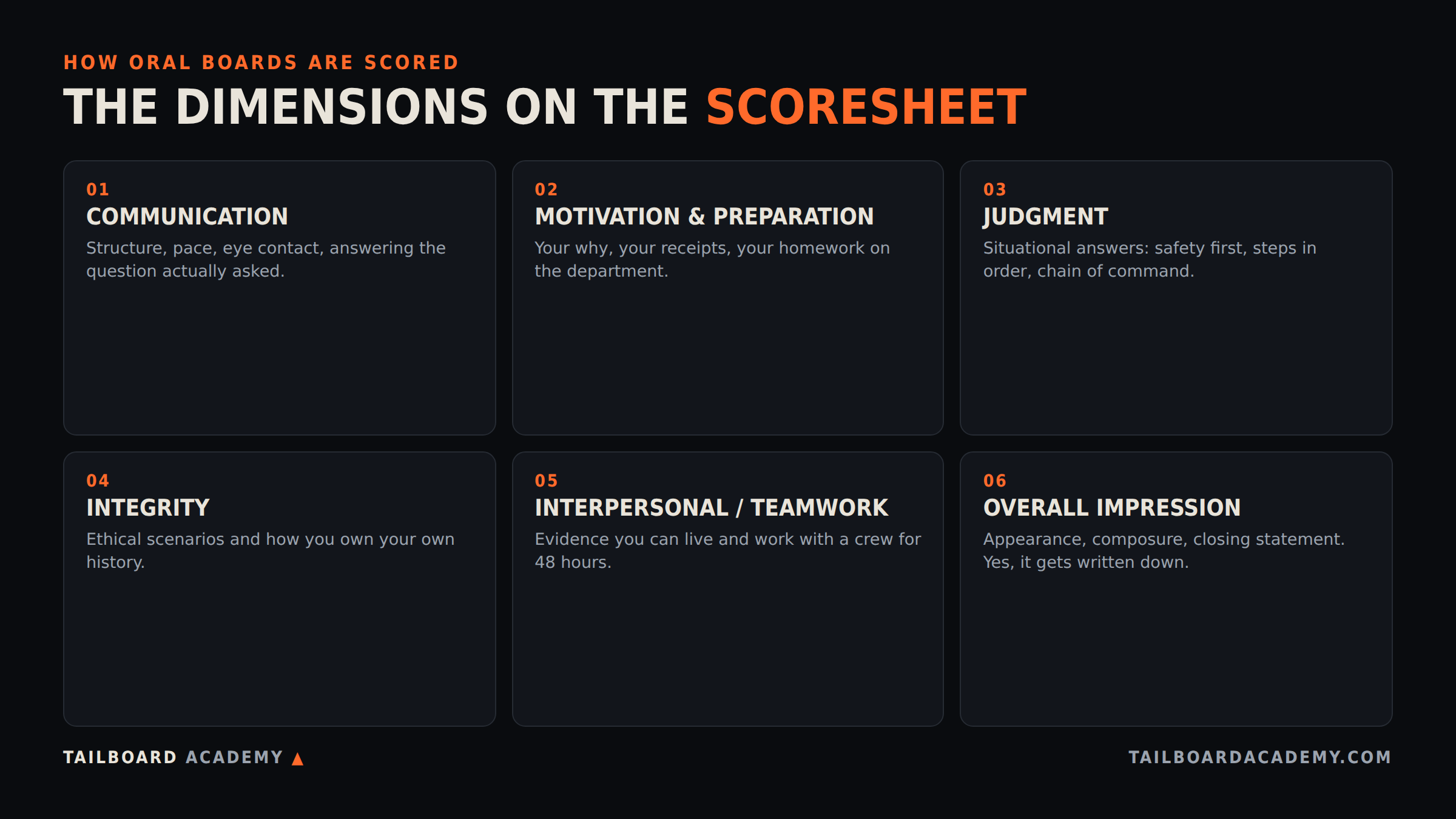
Exact labels vary by agency, but the dimensions cluster the same way almost everywhere:
Communication. Did you answer the question that was asked, in an organized way, at a listenable pace, with composure? This dimension is scored on every answer, which is why out-loud rehearsal moves your total more than any other prep.
Motivation and preparation. Your reasons for wanting the job, the evidence you've acted on them, and your homework on the department. Weak here looks like clichés; strong looks like receipts — certs, ride-alongs, specifics about their agency. Our breakdown of the 25 most common questions shows where this dimension gets probed.
Judgment. Scored mostly through situational questions. Raters listen for an ordered response: safety first, handle the immediate problem, use the chain of command, follow up. Skipping steps or freelancing costs points even when your instinct is right.
Integrity. The ethical scenarios — theft, cover-ups, your own history. These often carry outsized weight, and some agencies treat a failed integrity answer as disqualifying regardless of the rest of your total.
Interpersonal / teamwork. Evidence you can share a firehouse: conflict stories with clean resolutions, no trash-talk, realistic answers about living with a crew.
Overall impression. Appearance, bearing, opening and closing moments. Not every agency scores it as its own line, but every rater registers it.
How the math usually works
A typical setup: each rater scores each dimension (or each question) on a scale — 1–5, 1–10, or a 70–100 band are all common. Scores are summed or averaged across raters, sometimes with a minimum passing threshold per dimension. Your final number becomes your rank on the list, and departments hire down the list in order or in bands. Two practical consequences follow. First, small differences compound: a half-point per question across ten questions can be the gap between the top band and the middle of the list. Second, a single bombed dimension — usually integrity or judgment — can sink an otherwise strong performance.
If you want to see how this plays against real questions, run the scenario-heavy ones in our situational questions guide and score yourself honestly against the six dimensions above.
Reading about the oral board is step one. Sitting one is the rest. Tailboard runs a live panel that asks real follow-ups and scores you like a real board. Run one free, no card.
How to train against the rubric
Practice the way you'll be measured. After each rehearsal answer, grade yourself — or have someone grade you — dimension by dimension rather than asking "was that good?" Vague feedback produces vague improvement; dimension-level feedback tells you which points you're leaving on the table.
That's exactly how I built the scoring in Tailboard Academy's Oral Board Simulator. Three voiced panelists ask real board questions and press follow-ups, and every session ends with a written after-action scored across a five-dimension rubric — so instead of a feeling about how it went, you get the same kind of category-by-category read a panel produces. It's the closest thing I could build to seeing the scoresheet.
FAQ
What score do I need to get hired? There's no universal number — you need to land high enough on that agency's list for them to reach you before it expires. Practically, treat anything below the top band as a miss and prepare accordingly.
Do raters compare notes during the interview? Usually not during. Most processes have raters score independently, and scores are combined afterward — another reason consistent, structured answers matter: they have to land with every rater, not just the friendly one.
Are oral board scores subjective? Partly — humans hold the pens. But the rubric constrains them, and most panels include trained raters. Structured, evidence-backed answers reliably outscore winging it precisely because rubrics reward what's demonstrable.
Can I ask for my score afterward? Many civil-service processes will give you your score or rank on request, and some states require it. Fewer share the per-dimension breakdown — which is exactly the feedback gap deliberate practice has to fill.
Do all departments use the same rubric? No. Labels and weights vary, but the dimension clusters above cover nearly every scoresheet you'll face. Prepare for the dimensions and the local variations take care of themselves.
Practice against a rubric, not a mirror. Tailboard Academy's Oral Board Simulator scores every session across a five-dimension rubric with a written after-action — three voiced panelists, live follow-ups. Built by a working SoCal firefighter/paramedic. Run a free board — no card.
By John — active Southern California firefighter/paramedic. He went through this hiring process himself and built Tailboard Academy's Oral Board Simulator: three voiced panelists, live follow-up questions, and a written after-action after every session.