CPAT Test Breakdown: All 8 Events, in Order, With Pass Standards
The Candidate Physical Ability Test is a timed, pass/fail circuit: eight job-simulation events, completed in order, in 10 minutes and 20 seconds, wearing a 50-pound vest (75 pounds total on the stair climb). No rest stations, no do-overs on the clock — you walk a marked 85-foot path between events, and walking is your only recovery.
Knowing the events in order matters more than people expect, because the CPAT is a sequencing problem: early pacing mistakes and cumulative grip fatigue fail more candidates than raw strength ever does. Here's each event, what it simulates, and where it bites. (For the how-to-train side, pair this with the CPAT training plan.)
The ground rules
Fifty-pound weighted vest throughout, simulating an SCBA and turnout ensemble. On the stair climb only, two additional 12.5-pound shoulder weights simulate a hose bundle — 75 pounds total. Running is prohibited on the transition walks. Certain actions fail you instantly on specific events (falling off the StepMill after the start, letting the ladder fall, running). Finish all eight under 10:20 or it's a retest.
The eight events
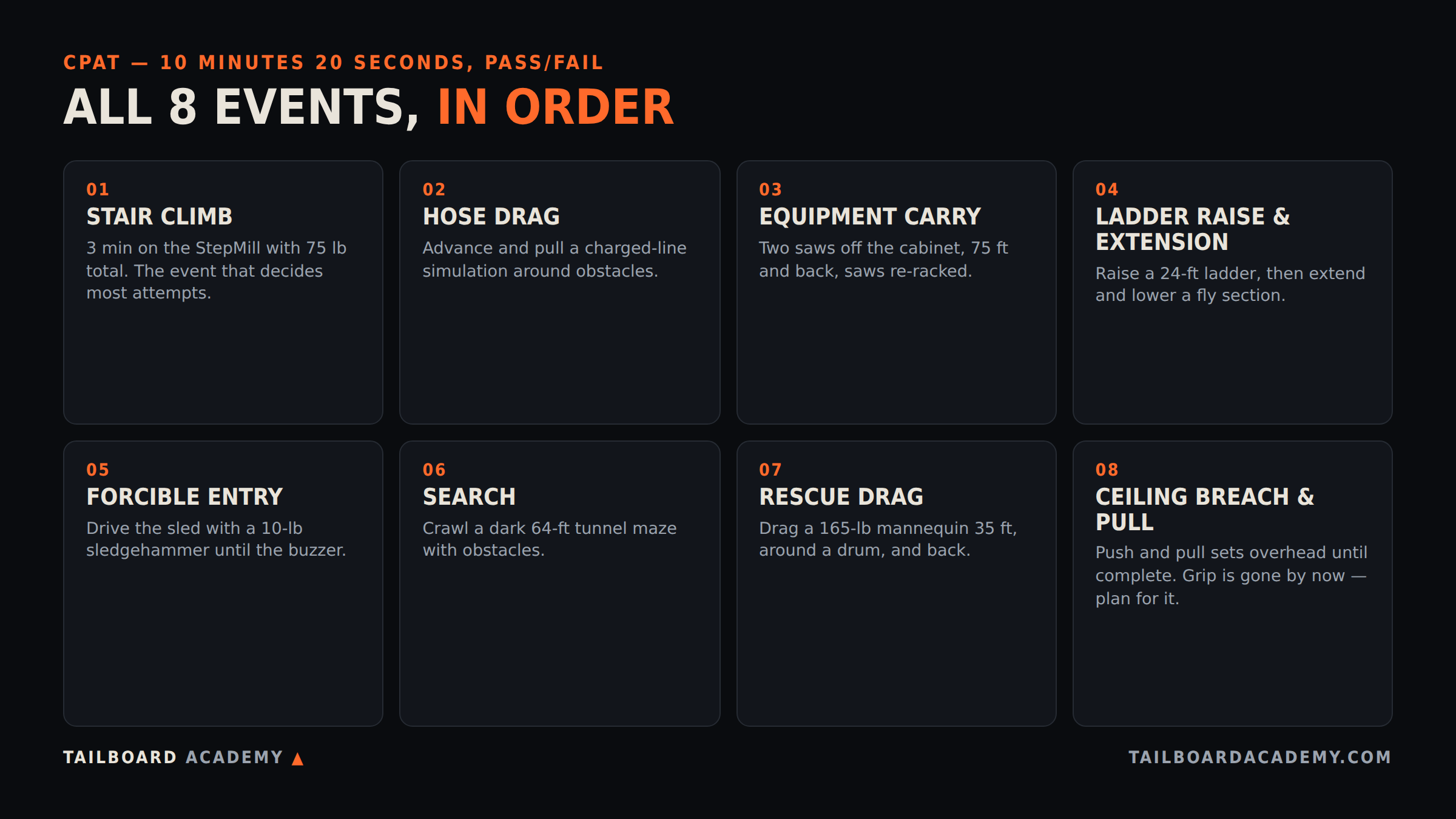
1. Stair climb. Three minutes at 60 steps per minute on a StepMill, at 75 pounds, after a 20-second warm-up. It's first, it's the heaviest load, and it decides more attempts than any other event — the details are in why people fail the CPAT. Train legs and pacing, not heroics: grabbing the rails for support fails you.
2. Hose drag. Shoulder a hoseline nozzle, advance 75 feet, make a 90-degree turn around a drum, continue, then drop to a knee and hand-over-hand another 50 feet of line into a marked box. First big grip-and-posture tax after the climb.
3. Equipment carry. Two saws off a cabinet shelf, carried one in each hand 75 feet out and back, then re-racked. Simple — unless your grip is already cooked.
4. Ladder raise and extension. Raise a 24-foot extension ladder flat off the ground rung by rung, then extend a fly section with the halyard and lower it under control. Letting anything drop uncontrolled is an event failure. Technique beats muscle here more than anywhere on the course.
5. Forcible entry. Drive a measuring device with a 10-pound sledgehammer until the buzzer sounds, feet outside a marked box. Hip rotation and accuracy, not arm swings.
6. Search. Crawl a dark tunnel maze roughly 64 feet long with turns, obstacles, and narrowed sections. Claustrophobia is discovered here, not trained here — do the practice run.
7. Rescue drag. Drag a 165-pound mannequin 35 feet, around a drum, and 35 feet back, using the harness handles. The single most anaerobic event, arriving when you're most spent.
8. Ceiling breach and pull. With a pike pole: push a hinged ceiling panel three times, pull a counterweighted apparatus five times, repeat the set four times. Your forearms are empty by now — which is precisely the test.
The clock strategy
The 85-foot transition walks are the whole game. Walk them briskly — every second banked early is breathing room during the rescue drag — but never so fast you redline before event four. The candidates who pass comfortably treat the CPAT as a 10-minute effort with eight work intervals, not eight separate max efforts. Most who fail either blow up chasing the clock in the first half or stroll the walks and discover the math doesn't work in the second.
Knowing the events is step one. Training for them is the rest. Tailboard builds a CPAT or Biddle plan around your current fitness and the date you actually test.
Where to go from here
Knowing the sequence is the easy half. Building the engine to survive it is the other one, and it takes a calendar: the 12-week CPAT training plan covers the conditioning, the grip work, and how to phase it. If your test is close and you want to know where attempts actually die first, start with why people fail the CPAT.
One logistical note worth having: licensed CPAT centers offer orientation sessions and timed practice runs, and in California the FCTC administers the test statewide as part of the standard hiring pipeline. Take the practice run if it's offered — it's the only place you'll touch the real StepMill and the real ladder before it counts.
The CPAT is also the easy half of the gauntlet, physically measurable and objectively passable. The event that actually ranks you — the oral board — has no practice course in most towns. That's the half I built Tailboard Academy's Oral Board Simulator for: three voiced panelists, live follow-ups, a written after-action, as many reps as you need.
FAQ
How hard is the CPAT to pass? For candidates who train specifically for it, pass rates are high. The failures concentrate among people who show up cold, underestimate the stair climb, or have never worn 50 extra pounds while working.
Can I run between events? No — running fails you. The transition walks are mandatory recovery; use them deliberately.
What should I wear? Long pants, shirt, closed-toe athletic shoes, and gloves are the standard requirement; hard hat and vest are provided. Check your testing center's specifics.
How long is a CPAT card valid? Most departments accept results within 12 months of the test date, but acceptance windows vary by agency — verify against each application you file.
Is the CPAT the same everywhere? The CPAT itself is a standardized, licensed test (developed under the IAFF/IAFC wellness initiative), so events and standards are consistent. A minority of departments use their own physical tests instead — read each job posting.
The CPAT has practice runs. Your oral board should too. Tailboard Academy's Oral Board Simulator gives you unlimited scored reps — three voiced panelists, live follow-ups, written after-actions. Built by a working SoCal firefighter/paramedic. Run a free board — no card.
By John — active Southern California firefighter/paramedic. He went through this hiring process himself and built Tailboard Academy's Oral Board Simulator: three voiced panelists, live follow-up questions, and a written after-action after every session.