Firefighter Oral Board Questions: The 25 You'll Actually Get (and How to Answer Them)
You can be first on the written exam and crush the CPAT, and none of it matters if you stall out in a folding chair in front of three strangers. For most departments, the oral board is the heaviest-weighted event in the entire hiring process — often 100% of your ranking score once you've passed the earlier gates.
Here's the good news: oral boards are predictable. Panels across the country pull from the same handful of question types, because they're all trying to measure the same things — judgment, integrity, motivation, and whether they'd want to spend a 48-hour shift with you. This guide covers the 25 questions that show up again and again, why each one is asked, and how to build answers that sound like you instead of a memorized script.
How the oral board actually works
Most entry-level boards look like this: a panel of two to four raters — usually a mix of company officers, chief officers, and sometimes an HR representative — asking every candidate the same scripted questions in the same order. You'll typically get 20–30 minutes. Raters score each answer against a rubric while you talk, and your final score usually decides your position on the eligibility list.
Three things follow from that format, and they should shape how you prepare:
Every candidate gets the same questions. The panel can't riff or chase tangents the way a casual interviewer might, which is exactly why the questions are so predictable — and so worth rehearsing.
They're scoring dimensions, not trivia. A question about a coworker drinking on the job isn't a policy quiz. It's measuring integrity and courage. When you understand what a question is for, the "right" answer usually becomes obvious.
The first two minutes matter disproportionately. Raters are human. A composed, structured opening answer sets an anchor for everything that follows.
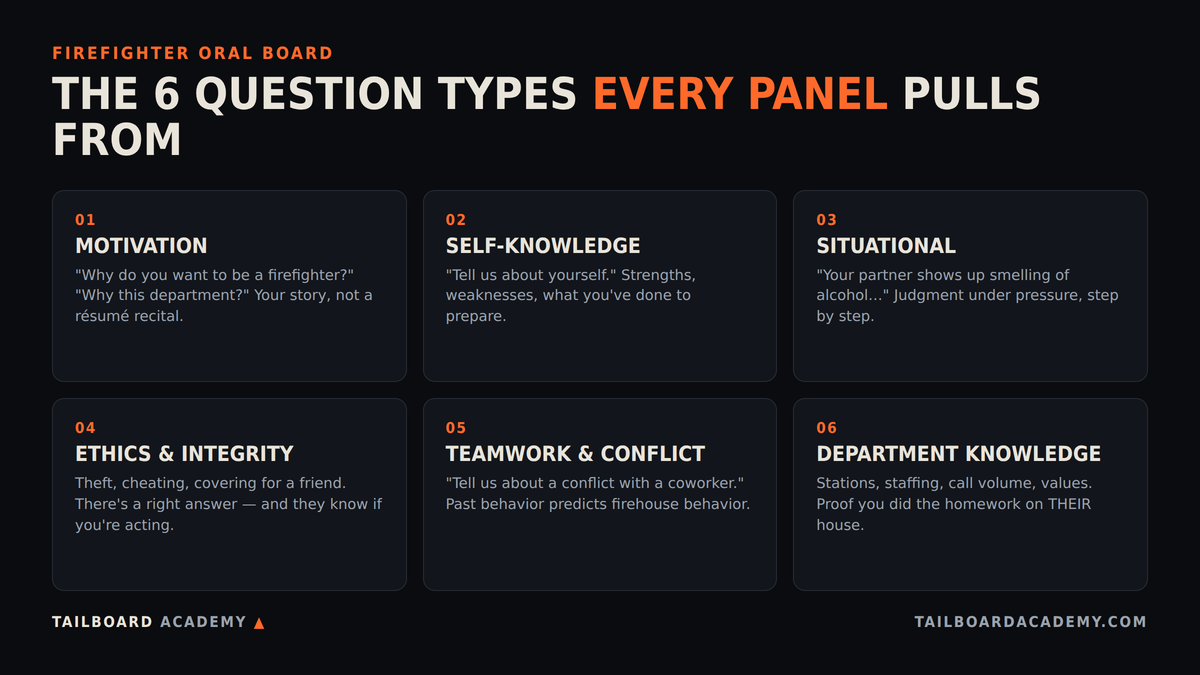
The six question types
Every question below fits one of six buckets. Learn the buckets and you can handle a question you've never heard, because you'll recognize what it's really asking.
The 25 questions
Motivation (the openers)
1. Why do you want to be a firefighter? The most asked question in the fire service, and the most fumbled. "I want to help people" is what everyone says. Panels want a specific origin, evidence you've acted on it, and proof your eyes are open to the hard parts of the job. We break this one down line-by-line in How to Answer "Why Do You Want to Be a Firefighter?".
2. Why do you want to work for THIS department? This is a homework check. Know their stations, staffing model, call volume, special teams (hazmat, USAR, wildland), and something real about the community they protect. "You guys are the best" scores zero. "You run a busy EMS system and I want to be a paramedic in a system that uses them aggressively" scores.
3. What have you done to prepare for this career? Inventory question. EMT or paramedic school, fire technology classes, academy, ride-alongs, volunteering, CPAT completion, this very interview prep. Have it organized chronologically and keep it under 90 seconds.
4. What do you know about the duties of a firefighter? They're checking for a realistic picture: fires are a small slice; EMS runs, training, station duties, public education, and 2 a.m. wake-ups are the job. Candidates who only talk about fires flag as romanticizers.
5. Where do you see yourself in five or ten years? Safe ground: promoted competence. "Off probation, a solid firefighter my crew trusts, then working toward paramedic/engineer — and eventually mentoring the next candidate sitting in this chair."
Self-knowledge
6. Tell us about yourself. Not your autobiography. A 60–90 second arc: where you're from, the moment this career grabbed you, what you've done about it, why you're in this chair today.
7. What is your greatest strength? Pick one relevant to a fire crew (reliability, composure, work ethic) and prove it with a story, not adjectives.
8. What is your greatest weakness? The trap is a fake weakness ("I care too much"). Give a real one, then show the system you built to manage it. Raters respect self-awareness; they punish polish without substance.
9. What would your last employer say about you? Assume they'll actually call. Be accurate, lead with the good, and if there's a blemish, own it before the background investigator finds it.
10. What accomplishment are you most proud of? Choose something earned, recent, and ideally team-adjacent. Explain the obstacle, not just the trophy.
Situational judgment
For every scenario question, use the same skeleton: ensure safety → address the immediate problem → use your chain of command → follow up honestly. Say your steps out loud in order.
11. You're driving the engine and your captain tells you to run a red light with no emergency. What do you do? Safety and policy beat rank. You don't run the light; you respectfully state why; if pushed, you comply with the law and address it through the chain afterward.
12. Your partner shows up to shift smelling of alcohol. What do you do? The classic. You cannot let them work — lives and licenses are on the line. Pull them aside, give them the chance to self-report, and if they won't, you take it to the company officer. Loyalty to the crew never outranks the public's safety.
13. A senior firefighter tells you to skip a safety step "because that's how we've always done it." What do you do? Respect experience, follow the safety standard anyway, and escalate only if the pressure continues. They're testing whether probies can hold a line politely.
14. You respond to a call and the patient is a family member. What do you do? Notify your officer immediately, request another unit if appropriate, and continue care until relieved. Composure plus disclosure.
15. You make a mistake on scene that nobody saw. What do you do? Report it. Every time. This is an integrity question wearing a scenario costume.
Ethics and integrity
16. You see a coworker take money from a patient's home. What do you do? No warnings, no cover. It goes to your officer immediately. Theft on a medical call is a career-ender and a crime; hesitation in your answer is a red flag.
17. Your best friend on the crew asks you to lie for him on a timecard. What do you do? "No" — delivered with empathy but zero wiggle. Then explain the why: trust is the entire currency of a fire crew.
18. Have you ever done something you're not proud of? Tell us about it. They have your background packet. Pick something real, take responsibility without excuses, and show what changed. Rehearsed perfection reads as evasion.
Teamwork and conflict
19. Tell us about a time you had a conflict with a coworker or supervisor. How did you handle it? Use a real story with a clean shape: the disagreement, the conversation you initiated, the resolution, the working relationship afterward. Never trash the other person.
20. Tell us about a time you worked on a team under pressure. Sports, military, restaurant rushes, retail holidays — anything real. Emphasize your specific role and communication.
If your example is military: strip the acronyms before you open your mouth. "I was a team leader responsible for four soldiers" scores. "I was an 11B fire team leader" makes the panel guess, and a rater who is guessing is not writing down points. Name the job in plain words, say what you personally did, and land on the communication, because that is the dimension this question is actually scoring. See the worked veteran examples in "tell me about yourself" and "why do you want to be a firefighter".
21. How would you handle living with someone you don't like for 48 hours straight? The firehouse question. Professional courtesy, find common ground, keep the friction off the fireground, and address real issues directly and privately.
22. What would you do if you were being hazed or witnessed harassment at the station? Modern departments take this seriously and so should your answer: address it directly if safe, document, use the chain of command, no participation in "tradition" that crosses the line.
Department knowledge and closers
23. What do you know about our department? See #2 — but this version is open-ended, so have five concrete facts ready and stop talking when you've landed three or four of them well.
24. What is the biggest challenge facing the fire service today? Solid lanes: recruitment and retention, firefighter cancer prevention, mental health, expanding EMS demand, wildland-urban interface. Pick one you can discuss for 60 seconds and connect it to how you'll show up.
25. Do you have anything to add? / Why should we hire you? Never waive it. This is your 30-second closing argument: recap your preparation, state plainly that you want THIS job at THIS department, and thank the panel. Last words linger into the scoring huddle.
Reading about the oral board is step one. Sitting one is the rest. Tailboard runs a live panel that asks real follow-ups and scores you like a real board. Run one free, no card.
A 3-week prep plan
Week 1 — Build your raw material. Write your origin story, your preparation inventory, five facts about the target department, and one real story each for conflict, pressure, mistake, and pride. Bullet points, not scripts.
Week 2 — Structure your answers. Turn each bucket above into a framework you can flex, not a monologue you recite. Practice the situational skeleton (safety → problem → chain of command → follow-up) until it's reflexive.
Week 3 — Rehearse out loud, under pressure. This is the step almost everyone skips, and it's the one that separates the top of the list from the middle. Reading answers silently does not prepare your mouth, pace, or nerves for saying them to human faces with a clock running.
I went through this process myself as a candidate in Southern California — I know exactly what it feels like when question 12 lands and your mind blanks. That gap between knowing your answer and delivering it is why I built Tailboard Academy's Oral Board Simulator: three voiced panelists who ask real board questions, press you with live follow-ups, and hand you a written after-action on every answer. It's the closest thing to repping the actual room without burning a real interview to practice.
Practice the room, not just the answers
However you rehearse — a mirror, a mentor, a mock board at your college fire program, or Tailboard's Oral Board Simulator — get the reps out loud. Ten spoken run-throughs beat a hundred silent reads. Start with our oral board overview guide, and check the fire service FAQ for the rest of the hiring pipeline.
FAQ
How long is a firefighter oral board interview? Most run 20 to 30 minutes, with 8 to 12 scripted questions asked identically of every candidate. Some departments add a short chief's interview later in the process, which is a different, more conversational format.
What should I wear to a firefighter oral board? A suit, or at minimum a pressed shirt and tie. Panels routinely note appearance in their scoring comments. Overdressed is a non-issue; underdressed is a deduction you handed them for free.
Can I ask the panel questions at the end? Usually the oral board format doesn't invite candidate questions — that's chief's-interview territory. If offered, one thoughtful question is plenty. Never ask about salary or schedule.
How is the oral board scored? Raters score each answer against dimensions like communication, judgment, integrity, and motivation, then scores are averaged or summed to place you on the eligibility list. Exact rubrics vary; many California departments publish sample criteria.
How do I stop my mind from going blank? Structure and reps. If you've rehearsed the six question types out loud, a blank moment becomes "which bucket is this?" instead of freefall. It's also fine to pause: "That's a great question — give me a moment" reads as composure, not weakness.
Ready to rehearse the real thing? Tailboard Academy's Oral Board Simulator puts you in front of three voiced panelists with live follow-ups and a written after-action on every session — built by a working SoCal firefighter/paramedic. Run a free board — no card.
By John — active Southern California firefighter/paramedic. He went through this hiring process himself and built Tailboard Academy's Oral Board Simulator: three voiced panelists, live follow-up questions, and a written after-action after every session.