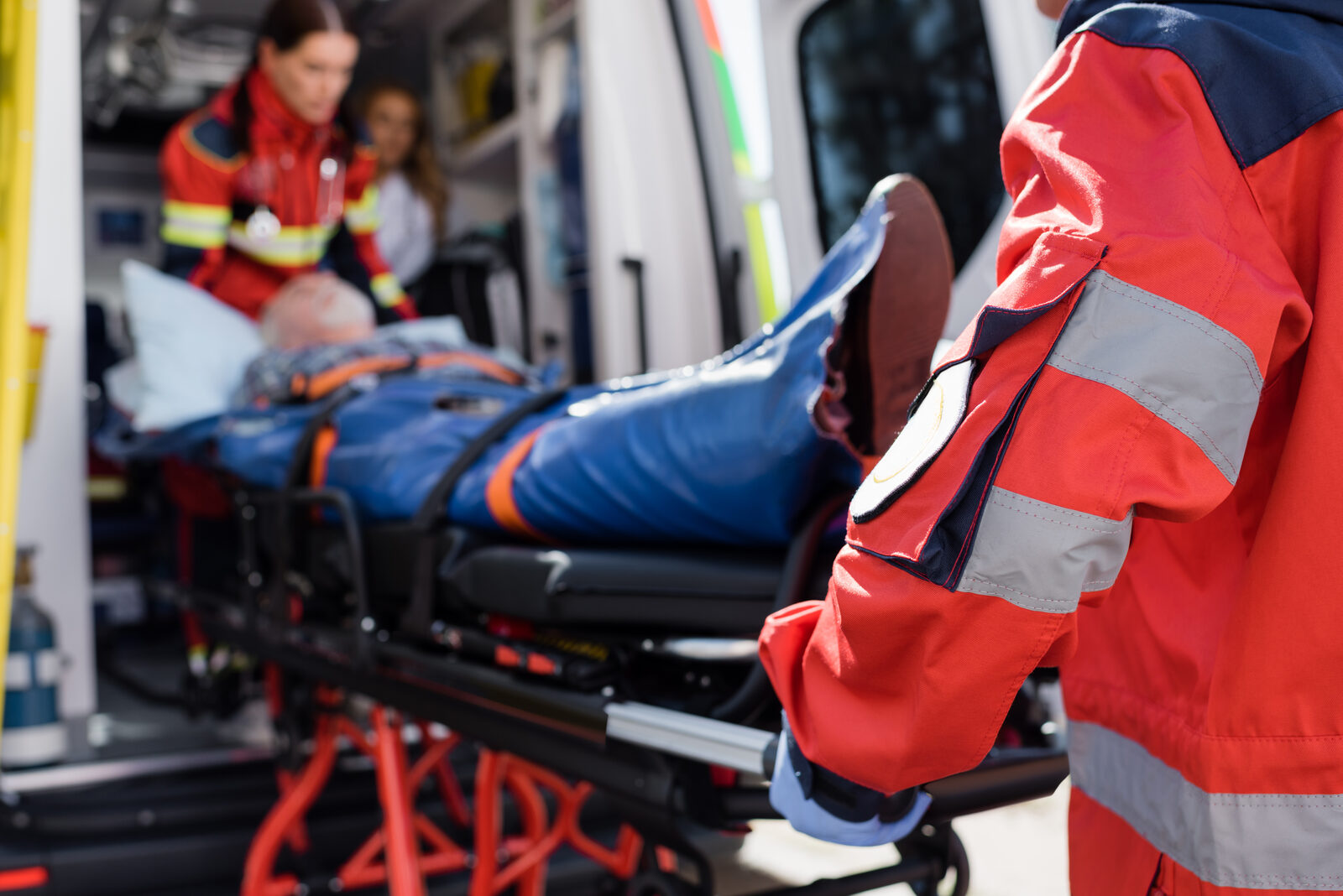
Do You Need to Be an EMT First? The Certifications That Actually Move Your Application
Short answer: at most career departments in California and much of the country, yes — EMT certification is either formally required by hire date or so universally expected that applying without it puts you at the back of a very long line. The structural reason is simple: the large majority of fire department call volume is emergency medical, not fire. Departments hire people who can run the calls they actually run.
The more interesting question is the second one — which certifications beyond EMT genuinely move an application, and which just decorate it. That's where candidates waste real money and real years.
What's required vs. what moves the needle
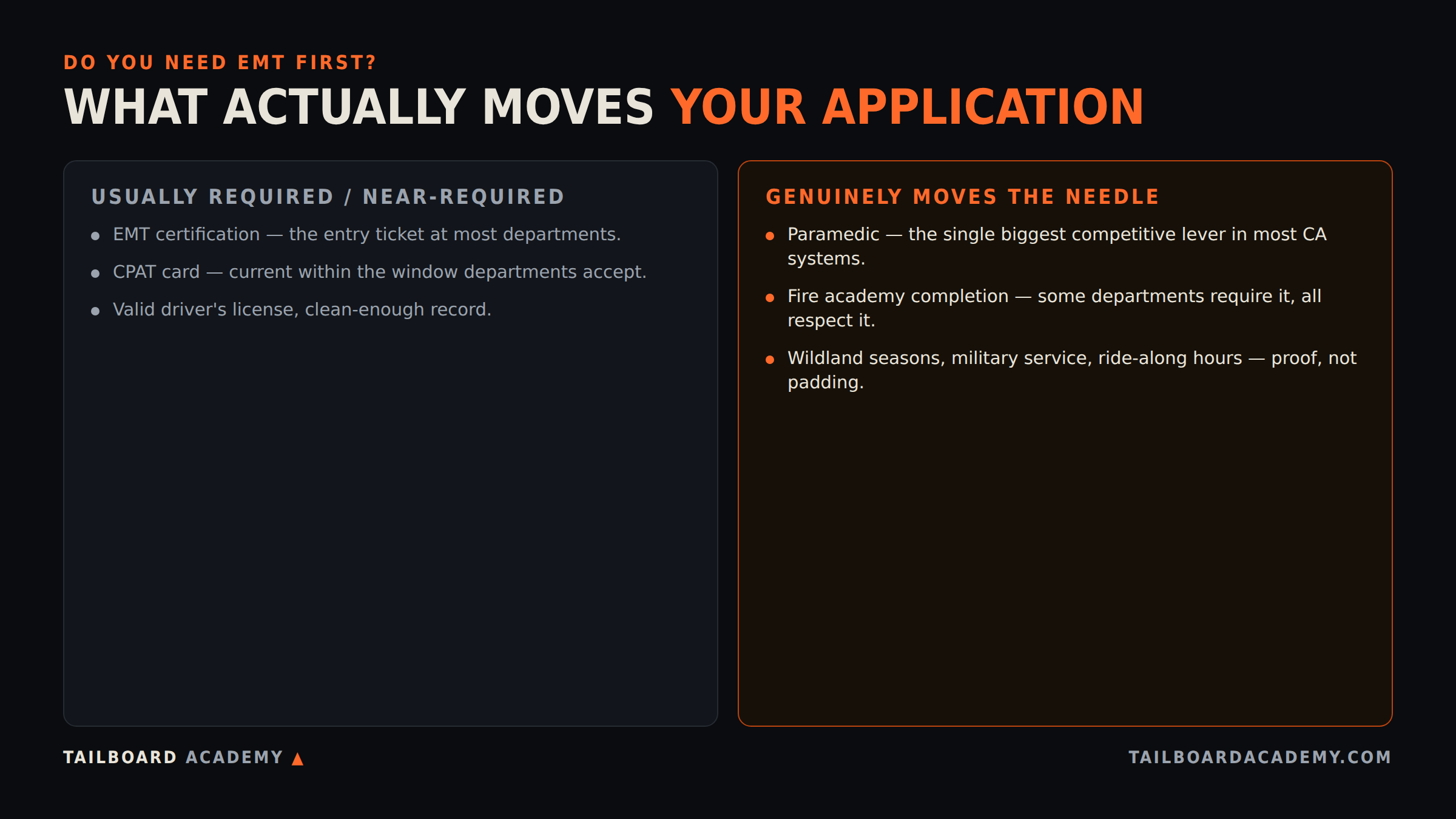
Effectively required: EMT certification, a current CPAT card, and a valid driver's license with a survivable record. These aren't differentiators; they're the table stakes that make you eligible at all — the pipeline mechanics are in the California hiring guide.
Genuinely moves the needle: paramedic licensure, a completed FF1 academy, and demonstrable experience — wildland seasons, military service, ambulance time, documented ride-alongs. These change how hiring panels read you, because each one is expensive proof rather than a purchased line item.
The paramedic question
Paramedic school is the single biggest competitive lever in most California systems — departments like Orange County hire firefighter/paramedics preferentially, some agencies hire only medics for certain classes, and a licensed paramedic can leapfrog years of list-waiting. It's also 12–18 months of demanding school, often costing five figures, with a license that then demands continuing education forever.
The honest decision framework: go medic first if your target departments visibly prioritize it, if you can afford the schooling window, and if you actually want the medicine — because you'll practice it for decades. Go EMT-and-test if you're competitive on boards now and your target lists move reasonably; you can always attend medic school later, sometimes on the department's dime. What fails is the middle path — drifting into medic school as a waiting room without checking whether your target departments reward it.
Certifications that mostly decorate
The certificate industry around fire hiring is bigger than its hiring impact. A drawer of weekend certs — hazmat awareness, ICS classes beyond the free FEMA basics, vendor "firefighter readiness" credentials — reads as padding to panels who know exactly what each one costs and teaches. One completed, accredited thing (a semester of fire technology, an FF1 academy, a wildland season) outweighs a stack of PDFs. If a cert doesn't represent either time under instruction or time doing work, it isn't moving your file.
FEMA's free independent-study ICS courses (100, 200, 700, 800) are the exception worth the evening they take: cost nothing, expected eventually anyway, and signal you've done the unpaid homework.
Reading about the oral board is step one. Sitting one is the rest. Tailboard runs a live panel that asks real follow-ups and scores you like a real board. Run one free, no card.
Sequence for a typical candidate
Start EMT school now — it's the gate everything else waits behind. Train for and bank the CPAT during EMT school. Take every written you can reach (practice tests first), and start testing with departments the month your EMT card arrives. Decide on paramedic school only after you've seen your board scores and your target lists — real data beats defaulting into more school. And through all of it, remember what the certifications are for: they get you to oral boards. They don't score a single point once you're in the chair — the panel assumes everyone's paperwork qualifies, and then ranks the humans. I went through exactly this sequence myself, and the chair is where the separation happened; it's why Tailboard Academy's Oral Board Simulator is the tool I wish had existed alongside my EMT card.
FAQ
Can I get hired as a firefighter with no EMT? At some departments, technically yes — usually with a requirement to certify by hire or during the academy. Practically, competitive applicants have it before applying, and many postings screen for it outright.
Is EMT school hard? It's a focused semester: anatomy basics, assessment, protocols, skills testing, then the NREMT exam. Working adults complete it at night routinely. Treat the NREMT like the real test it is — adaptive format, no gimmes.
Should I work on an ambulance before applying? It helps more than almost any certificate: real patient contacts, real references, and material for every board answer about pressure and teamwork. Even six months of IFT work reads as proof.
Do fire science degrees matter? Units help some applications and promotions later; the degree alone doesn't outrank a medic license or academy completion for entry hiring. If choosing where a limited budget goes: EMT → academy/experience → medic, in that order.
Does military experience substitute for certifications? It doesn't replace EMT/CPAT requirements, but it weighs heavily at every human gate — boards, chiefs, background. Veterans' preference points are also real at many civil-service agencies; claim them.
Certs get you to the chair. The chair decides the list. When your paperwork's in order, rehearse the part that ranks you — Tailboard Academy's Oral Board Simulator: three voiced panelists, live follow-ups, written after-actions. Built by a working SoCal firefighter/paramedic. Run a free board — no card.
By John — active Southern California firefighter/paramedic. He went through this hiring process himself and built Tailboard Academy's Oral Board Simulator: three voiced panelists, live follow-up questions, and a written after-action after every session.