"Tell Me About Yourself" for the Firefighter Interview: A 90-Second Framework
It's usually the first thing out of the panel's mouth, and it has no question mark in it — which is exactly why it wrecks people. Candidates either recite their whole life story for four minutes or freeze and deliver three sentences of résumé. The fix is a shape: a 90-second arc that grounds who you are, names the moment this career became real, lists your receipts in order, and lands on why you're in this chair today.
This answer matters more than its content deserves, because it's scored on communication and it anchors the panel's impression for everything that follows. Nail the opener and the raters lean in for the next twenty-five minutes.
What the panel is actually asking
Not "narrate your life." The real question is: can you organize your own story, and does it end here on purpose? Raters are reading structure (can you build an answer with a beginning and an end), self-awareness (do you know which parts of your life are relevant), and trajectory (does your path make this job look inevitable or accidental). Everything you include should serve one of those three reads. Your childhood dog, your GPA, and your fantasy football title do not.
The 90-second arc
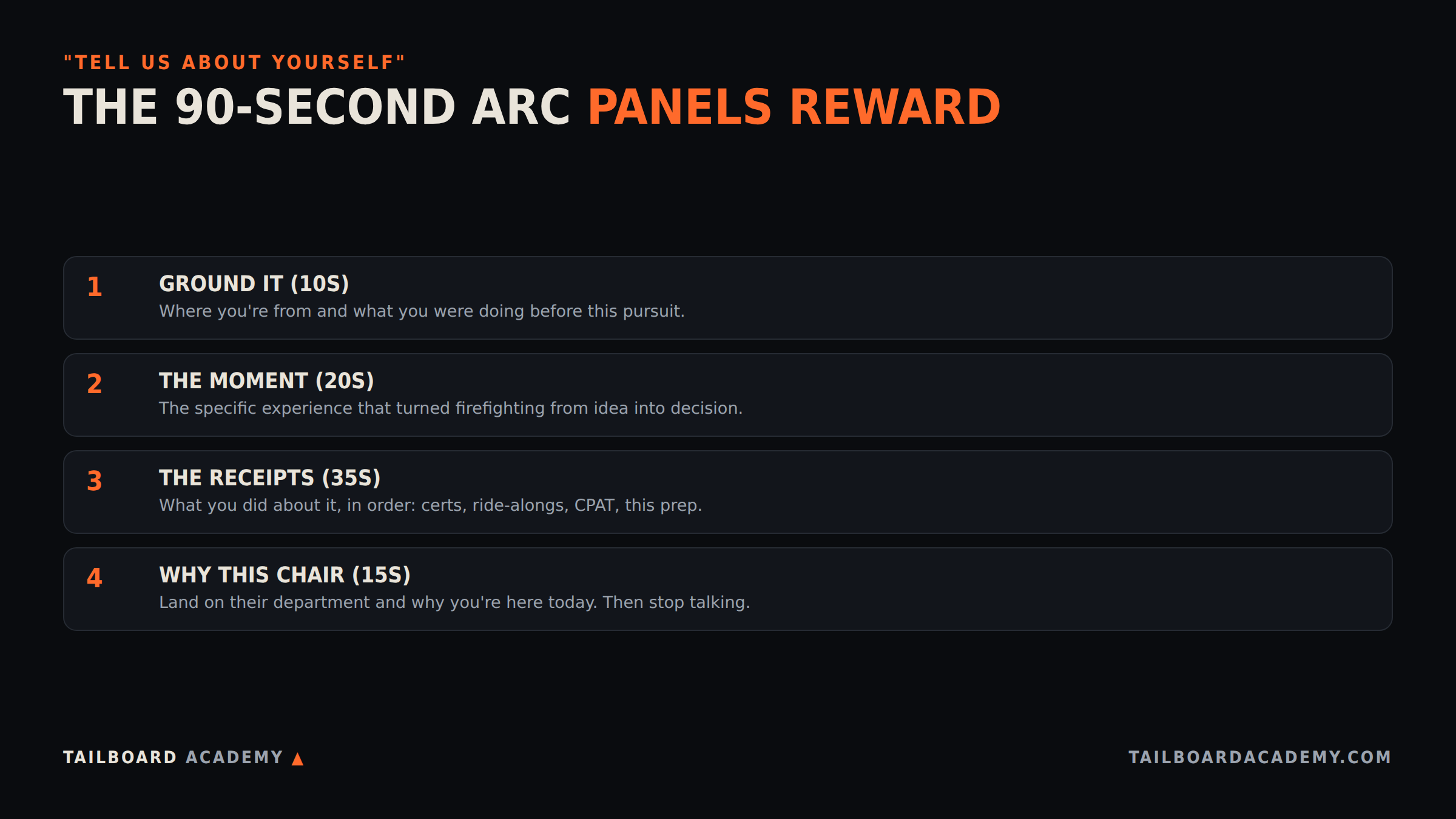
Ground it — about 10 seconds. Where you're from and what you've been doing. One or two sentences of context so the rest has somewhere to live. "I grew up in Riverside, and for the last three years I've been working construction while finishing my EMT."
The moment — about 20 seconds. The specific experience that turned firefighting from an idea into a decision. This is the same beat that anchors your answer to "why do you want to be a firefighter" — and yes, it's fine that they overlap; consistency across answers is a feature, not a bug. Chiefs and panels compare notes.
The receipts — about 35 seconds. What you did about it, in chronological order: EMT school, ride-alongs, fire tech units, CPAT passed, volunteering, this prep. This is the longest beat because it's the most scoreable one — every item is verifiable evidence of motivation.
Why this chair — about 15 seconds. Land the plane on their department and today: "That's what brought me here — I want to do this job in a busy system, and this department is where I want to earn that." Then stop talking. The most common failure isn't a bad answer; it's a good answer that runs ninety seconds too long.
A full example
"I grew up in Riverside, and for the past three years I've been framing houses while putting myself through EMT school at night. The turn for me came two summers ago — my crew was first at a jobsite accident, and while we waited for the engine I realized I was the calmest person there and the least useful. That bothered me for weeks, and then I did something about it. I finished my EMT in the spring, I've logged about eighty hours of ride-alongs with two departments, I passed the CPAT in March, and I've spent this year preparing for these boards specifically. Construction taught me crews — early mornings, hard days, people you have to count on. I'm here because I want that, plus the calls. This department runs busy, trains hard, and that's where I want to start my career."
Seventy-ish seconds spoken. Notice: no adjectives about himself ("hard-working," "passionate") — the facts carry all of it.
The same answer, coming out of the military
The arc doesn't change. What changes is that you have to translate before you speak, because a panel that can't follow your answer can't score it. Two versions of the same beat:
Don't say this. "I was an HM2, NEC L50A, SAR med tech attached to HSC-3, aircrew qualified with 200-plus hours, collateral duty as the command ADPAAM."
Say this. "I was a Navy rescue medic on a helicopter crew. I was the only medical provider on board, so when we hoisted someone off a mountain or out of the water I was treating them alone, in the aircraft, until we landed."
Same facts. One of them is scoreable. Here is a full 90 seconds built that way, from an Army infantry background rather than a medical one, because most veterans applying are not medics:
"I'm from Bakersfield. I spent five years in the Army as an infantry team leader, three of them responsible for four soldiers: their training, their equipment, and whether they were ready to go. I got out in 2024. The turn for me happened on a deployment when our medic worked on someone for twenty minutes with what he had in his bag, and I was standing there holding a light. I could carry the litter and that was it. I wanted to be the one who could actually do something. So I finished my EMT last spring, I've been working ambulance in Kern County since June, I passed the CPAT in August, and I've been running mock boards to get ready for this. The Army taught me crews and it taught me standards, and I know I'm starting over at the bottom here, which is fine. I want to learn this job in a busy system, and this is the department I want to learn it in."
What that answer does right: no rank worship, no acronyms he didn't explain, one clear statement that he expects to start as a probationary firefighter like everyone else, and a landing on this department instead of on his service. What it leaves out is just as important. He never said "I served," never asked for credit for serving, and never used a single word the panel would have to guess at.
If you're staring at your own record trying to find that thread, that's exactly what the Veteran Translator does: you give it your rate or MOS, your billets and your quals, and it gives you back bullets and a spoken opener in plain language. It only reframes what you enter, so check every line before you say it out loud.
Reading about the oral board is step one. Sitting one is the rest. Tailboard runs a live panel that asks real follow-ups and scores you like a real board. Run one free, no card.
What to cut
Anything before high school. Salary, schedule, benefits. Grievances about past employers. Long employment histories — compress to the relevant thread. And the phrase "as you can see on my application" — the panel decides what they can see. If a detail doesn't build toward this chair, it's cannibalizing seconds from something that does.
When I prepped my own version of this answer, the first drafts were pure autobiography — I had to cut most of my own story to find the thread that mattered. Rehearsing it out loud against Tailboard's Oral Board Simulator is what tightened it: the panelists' follow-ups showed me which details invited good questions and which invited none.
Practice the opener like it decides the interview
Because it partly does. Run your arc out loud with a timer until 90 seconds feels natural, then pressure-test it — a mentor, a mock board, or Tailboard's Oral Board Simulator, where the opener is question one and the written after-action tells you how it landed. Then work the rest of the room with the 25 questions you'll actually get.
FAQ
How long should "tell me about yourself" be? Sixty to ninety seconds. Under thirty reads unprepared; past two minutes you're spending the panel's patience before question two.
Should I include personal details like family or hobbies? Only if they build the thread — coaching youth sports shows teamwork; "I like hiking" is filler. One humanizing detail maximum, and make it earn its seconds.
Is it okay if this overlaps with my "why firefighter" answer? Yes — they share the "moment" beat. Tell the same true story both times; panels reward consistency and punish contradictions.
What if my background has a gap or a rough patch? Don't hide it; thread it. "After I lost my job in 2024, I used the year to finish my EMT" turns a gap into evidence of direction. Background investigators will see the timeline anyway — better that you narrated it first.
Do I stand or sit? Notes allowed? You'll almost always be seated, and no notes. Which is the real argument for rehearsing out loud: your structure has to live in your body, not on a card.
Your opener sets the anchor. Rehearse it against Tailboard Academy's Oral Board Simulator — three voiced panelists, live follow-ups, and a written after-action that scores how you actually sounded. Built by a working SoCal firefighter/paramedic. Run a free board — no card.
By John — active Southern California firefighter/paramedic. He went through this hiring process himself and built Tailboard Academy's Oral Board Simulator: three voiced panelists, live follow-up questions, and a written after-action after every session.