How Long Does It Take to Become a Firefighter? Every Stage of the Pipeline
The honest answer is 12 to 24 months for most first-time candidates — sometimes faster with luck and existing certs, often longer for competitive metro departments. Anyone promising a badge in 90 days is selling something. But the spread isn't random: each stage has a typical duration, some stages compress with effort, and some simply run on the government's clock. Knowing which is which is how you plan a life around the pursuit.
The stages
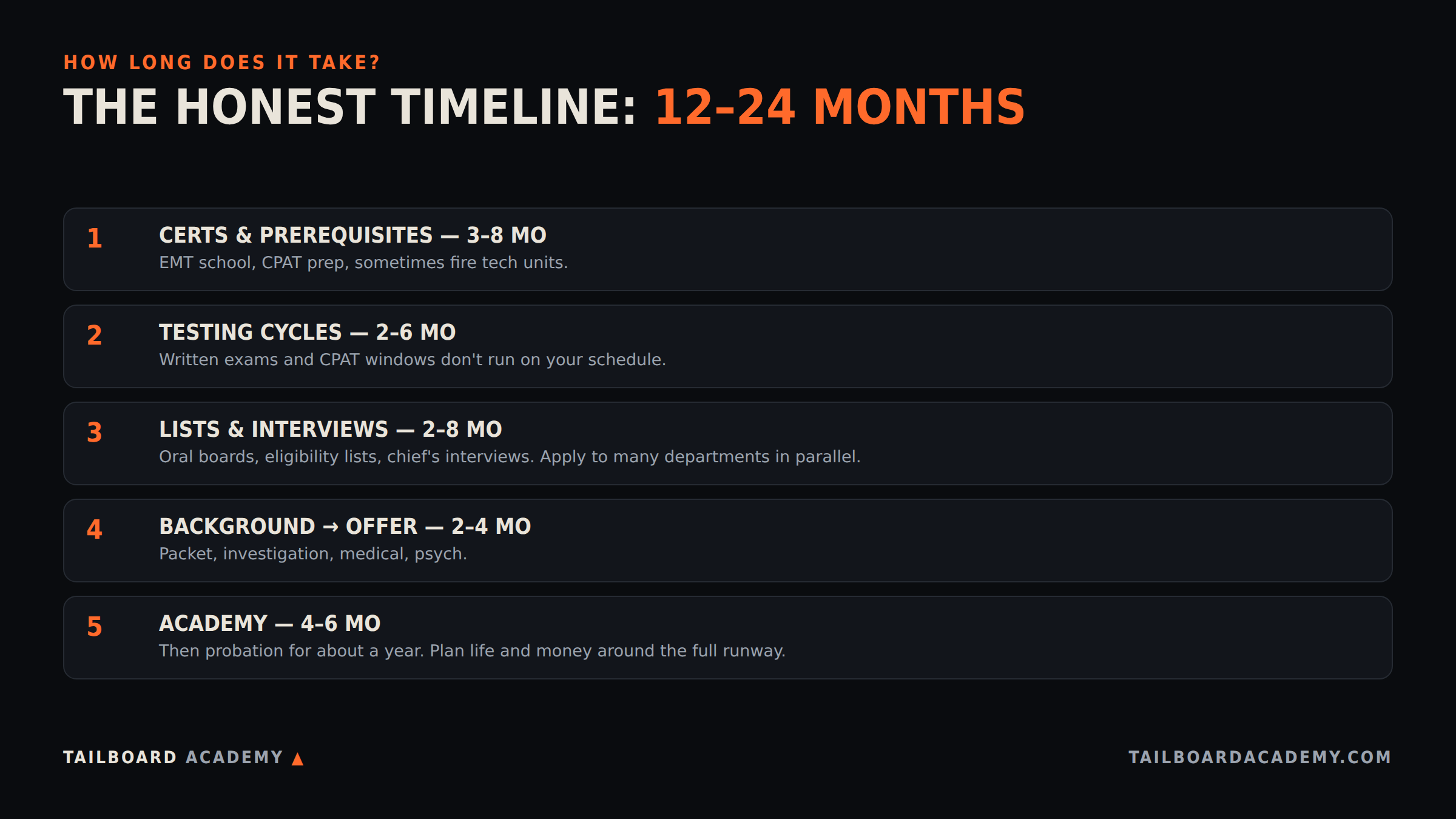
Certifications and prerequisites — 3 to 8 months. EMT school runs one semester full-time (accelerated programs compress to 8–12 weeks), plus NREMT testing and state certification. Add CPAT preparation — realistically 6–8 weeks of specific training — and optionally fire technology units or a pre-service academy, which extend this stage but strengthen everything after. This stage is fully yours to compress: enrollment dates and study pace are the levers you actually control.
Testing cycles — 2 to 6 months. Written exams and CPAT windows run on testing-center and department calendars, not yours. In California the FCTC schedule keeps this reasonably fluid; departments using their own exams may test once or twice a year, and missing a window means waiting for the next one. Compression strategy: test early, test everywhere, keep every card current.
Lists and interviews — 2 to 8 months. The widest, least controllable stage. Eligibility lists get established, certified, and drawn from on each department's timetable; oral boards get scheduled in batches; some lists live two years and your rank determines whether the phone ever rings. The one lever you fully control here is your board score — the difference between top-band and mid-list is measured in months or in never. That's the stage covered by the oral board question guide and the reason it deserves the most rehearsal.
Background to offer — 2 to 4 months. Personal history statement, investigation, references, medical, psych — the slow grind detailed in the background and psych guide. Compression lever: paperwork returned fast, complete, and consistent. Delays here are usually candidate-caused.
Academy — 4 to 6 months. Municipal recruit academies run 16–24 weeks. Then probation — about a year — which is employment, but not yet security.
Why the range is so wide
Run the arithmetic and the honest spread emerges. A candidate with EMT already in hand, hitting an open FCTC window, scoring top-band on their first boards, and drawing a department actively hiring can compress to about a year. A candidate starting from zero, testing with one department a year, or landing mid-list can stretch past two — not from lack of ability, but from stacking uncontrollable calendars end to end. The single biggest structural accelerator is parallelism: testing with many departments at once means some list, somewhere, is always moving. The single biggest personal accelerator is board performance, because it converts "on a list" into "reachable on a list."
Watching my own timeline unfold through this process is what convinced me the board is the highest-leverage month of the whole pipeline — and it's why Tailboard Academy's Oral Board Simulator exists: three voiced panelists, live follow-ups, and written after-actions, so the stage that decides your list position gets real rehearsal instead of hope.
Reading about the oral board is step one. Sitting one is the rest. Tailboard runs a live panel that asks real follow-ups and scores you like a real board. Run one free, no card.
Planning your life around it
Treat the pursuit as an 18-month project with income. Keep the day job; schedule EMT school and CPAT training around it; bank money for the academy months in case your department doesn't pay recruits (most career departments do — pre-service academies you fund yourself). Tell the people close to you the real timeline so month nine doesn't feel like failure. Month nine is the middle, not the end.
FAQ
Can I become a firefighter in under a year? It happens — usually to candidates who started with EMT certification, tested into an actively hiring department, and scored top-band on the oral board. Plan for 18 months; celebrate if you beat it.
Does military or wildland experience speed it up? It strengthens your candidacy at every human gate — boards, chief's interviews, background — and CAL FIRE seasonal work can put you in the industry while municipal lists move. The calendars themselves don't shorten, but your odds at each gate improve.
How long are eligibility lists good for? Commonly one to two years, department-dependent. A high rank on a fresh list is the best position in the entire process; a low rank on an old list is a polite no.
Should I wait to apply until I'm fully prepared? No — testing is training. Early boards at departments you're lukewarm on are the best rehearsal for the one you want, and lists move slowly enough that early applications rarely cost anything.
What's the slowest part? Waiting on lists. It's also the stage where preparation already banked — your board score — does all the work. Control what ranks you; endure what doesn't.
The pipeline is long. The part you control most is one interview. Rehearse it with Tailboard Academy's Oral Board Simulator — three voiced panelists, live follow-ups, written after-actions. Built by a working SoCal firefighter/paramedic. Run a free board — no card.
By John — active Southern California firefighter/paramedic. He went through this hiring process himself and built Tailboard Academy's Oral Board Simulator: three voiced panelists, live follow-up questions, and a written after-action after every session.