How to Answer "Why Do You Want to Be a Firefighter?" (Without Sounding Like Everyone Else)
It's the first real question of almost every oral board, and panels have heard the same three answers hundreds of times: I want to help people. I've wanted this since I was a kid. I like that every day is different. None of those answers are wrong. They're just invisible — and on a board where your score decides your spot on the list, invisible is fatal.
The short version of this guide: a strong answer names a specific moment that pointed you at this career, shows the evidence of what you've done about it since, proves your eyes are open to the hard parts of the job, and lands on why this department specifically. Build those four parts and you'll sound like nobody else in the hallway — because nobody else has your story.
Why panels open with this question
Raters aren't asking to be polite. This question does three jobs at once. It tests whether you've actually examined your own motivation or just followed a childhood image of the job. It gives the panel their first read on your communication — structure, pace, composure — which anchors how they hear everything after. And it quietly screens for people chasing the paycheck, the schedule, or the image, because those candidates struggle through probation and the panel knows it.
Understand that, and the goal becomes clear: don't recite a virtue. Show your work.
What panels actually hear (weak vs. strong)
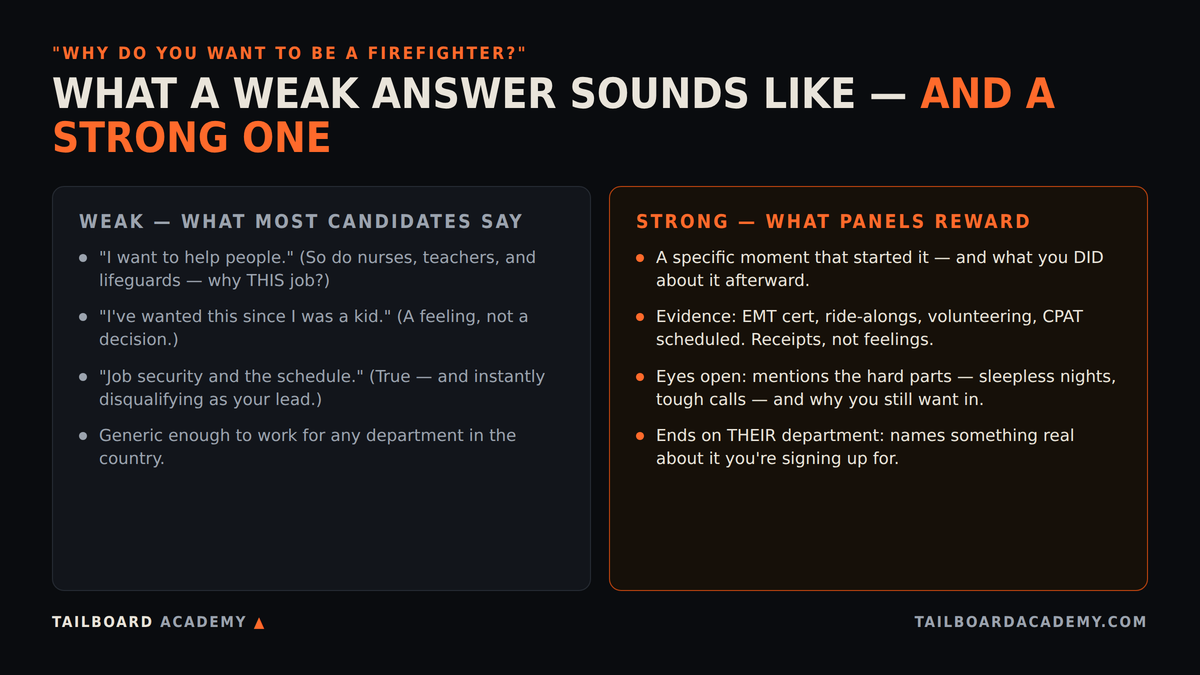
"I want to help people" fails not because it's false, but because it doesn't differentiate — nurses, teachers, and lifeguards help people. "Since I was a kid" fails because it describes a feeling, not a decision an adult made and acted on. "Job security and the schedule" is honest and instantly disqualifying as a lead — the panel already knows about the pension; they need to know you'd still want the job at 3 a.m. on your fourth call.
Strong answers share four traits, and they map to a framework you can build tonight.
The four-part framework
1. The moment (15–20 seconds)
Name the specific experience that turned this from an idea into a pursuit. A crash you witnessed. A medic crew that worked on your grandfather. A ride-along that rearranged your assumptions. It doesn't need to be dramatic — it needs to be yours, and it needs a time and a place.
2. The receipts (20–30 seconds)
What did you do about it? This is where your answer separates from the crowd, because claims are free and evidence isn't: EMT school, fire technology units, volunteer hours, ride-alongs, CPAT scheduled or passed, this interview prep. Two or three items, chronological, no padding.
3. Eyes open (10–15 seconds)
One sentence proving you know the real job: the sleepless nights, the routine EMS runs that make up most call volume, the calls that follow you home. Then why you want it anyway. This single beat is what convinces raters you'll survive probation with your motivation intact.
4. Their house (10–15 seconds)
Close on the department in front of you — something true and specific: their call volume, their paramedic program, their community, their reputation for training. Generic answers work anywhere, which is exactly why they score nowhere.
A full example answer
Here's the framework assembled, at roughly 75 seconds spoken:
"Two summers ago I was first on scene at a motorcycle accident on the 74 — before any units arrived. I did what I could with a first-aid kit and it wasn't much. What stuck with me wasn't the injury, it was the difference when the engine crew showed up: calm, coordinated, every person knowing their job. I wanted to be capable like that. Since then I've finished my EMT certification, put in about a hundred hours of ride-alongs with two departments, and passed the CPAT in March. The ride-alongs mattered most — I learned this job is mostly medical aids, station work, and training, not the fires on recruiting posters, and honestly that made me want it more, because the crews treated the routine calls with the same professionalism as the big ones. I'm applying here specifically because you run one of the busier EMS systems in the county and you put paramedics on every engine. That's the system I want to grow up in. This isn't a job I'd be trying out — it's the one I've been building toward for two years."
Notice what's absent: no "passion," no "calling," no "ever since I was little." Every sentence is either a fact or a decision.
Reading about the oral board is step one. Sitting one is the rest. Tailboard runs a live panel that asks real follow-ups and scores you like a real board. Run one free, no card.
If you're coming out of the military
You have a version of this answer that civilians can't touch, and a specific way to blow it. The way to blow it is to make your service the answer. "I want to keep serving" is the veteran equivalent of "I want to help people," and panels hear it every cycle. Service is your evidence, not your reason.
The other failure is language. If the panel has to decode your answer, they can't score it, and they will not stop you to ask what a rate or an MOS is. Say what you did, not what you were called.
Here's the framework with a Navy corpsman in it, same 75 seconds:
"In 2019 I was a Navy corpsman on a rescue helicopter crew. We hoisted a hiker off a ridge with a broken pelvis, and I worked on him alone in the back of the aircraft for about twenty minutes because I was the only medical person on board. That's the closest I've been to the job I'm sitting here asking for, and it's the part of the Navy I've missed every day since I got out. Since separating I finished my paramedic license, I've been running 911 in Riverside County for eighteen months, and I passed the CPAT in the spring. Working the ambulance is what showed me the fire side of it. We'd get on scene and the engine crew was already at work, and I wanted to be part of that crew instead of showing up to it. I know what I'm asking for. I'd be a probationary firefighter, bottom of the list, learning a job I've only seen from the outside, and that's fine with me. I'm applying here because you run paramedics on the engines and your call volume means I'd see enough to actually get good. I've done the version of this in a helicopter. I want to do it on an engine, here."
What that does: the moment is specific and dated, the receipts are civilian and verifiable, and the "eyes open" beat does double duty by saying out loud that he expects to start at the bottom. That single sentence answers the question every panel has about a veteran candidate and nobody will ask directly.
If your own record is still sitting in military language, that's the exact thing the Veteran Translator is for.
Make it yours (a 20-minute exercise)
Take a blank page and answer four prompts in bullet points: What moment made this real for me? What have I actually done since — with dates? What's the least glamorous truth I know about this job? What do I concretely know about the department I'm testing for? Then say it out loud — don't write a script. You want a shape you can flex, because a memorized paragraph shatters the moment your pace gets knocked by nerves, and panels can smell recitation a folding table away.
When I prepped for my own boards in Southern California, my early practice answers were built from the same clichés — most of the weak column above. It took spoken repetition, not more reading, to fix that. That experience is a big part of why I built Tailboard Academy's Oral Board Simulator the way I did: three voiced panelists who ask the question, interrupt with the follow-ups real panels use — "That's a nice story, but why not nursing?" — and give you a written after-action on exactly where your answer went generic.
Pressure-test it before the panel does
Once your answer holds up in the mirror, put it under load: have a mentor grill you, book a mock board, or run it against Tailboard's Oral Board Simulator until the follow-ups stop rattling you. Then move to the rest of the room — our guide to the 25 oral board questions you'll actually get covers the other 24, and the oral board overview maps the full event.
FAQ
How long should my answer be? Sixty to ninety seconds spoken. Under 30 seconds reads as unprepared; over two minutes and you're eating time the panel budgeted for scored questions. Practice with a timer — nerves stretch answers.
Is it okay to mention family in the fire service? Yes, as context — not as the whole answer. "My father was a firefighter" explains exposure, not motivation. Follow it immediately with the decisions you made: your certs, your ride-alongs, your reasons.
Should I admit the pay and schedule appeal to me? Don't lead with them, and don't volunteer them as motivation. If asked directly, be honest that they're benefits — then return to the substance. Panels distrust candidates who claim the compensation means nothing.
What if I don't have a dramatic origin story? You don't need one. A ride-along that changed your picture of the job beats an invented rescue story every time — and integrity questions later in the board have a way of finding invented stories. Specific and true beats cinematic.
Is this the same answer I'd give in the chief's interview? Same skeleton, more conversation. The chief's interview is less scripted and more personal, so be ready for follow-ups and keep the same facts consistent — chiefs compare notes with panel scores.
Rehearse it against a real follow-up. Tailboard Academy's Oral Board Simulator asks "why do you want to be a firefighter" — then pushes back the way real panels do, with three voiced panelists and a written after-action on every session. Built by a working SoCal firefighter/paramedic. Run a free board — no card.
By John — active Southern California firefighter/paramedic. He went through this hiring process himself and built Tailboard Academy's Oral Board Simulator: three voiced panelists, live follow-up questions, and a written after-action after every session.