Tailboard Academy is an EMS education platform: every student gets full NREMT-style prep for EMT and Paramedic, and the program gets a live console that shows who is ready, who is behind, in exactly what, and one button to fix it. Built by a working firefighter/paramedic and helicopter rescue medic; every clinical item reviewed by practicing medics.
The EMS platform, in every seat
- Exam Day: the full Registry simulation. Adaptive, blueprint-weighted, at the real lengths and clocks: EMT 70–120 questions / 2 h; Paramedic 110–150 / 3.5 h.
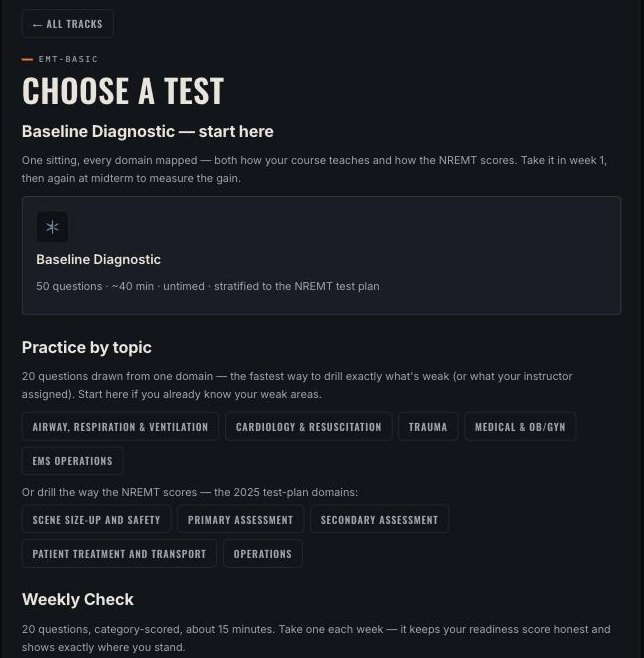
- Baseline Diagnostic + weekly checks. A 50-question day-one domain map, then fifteen minutes a week keeps it current.
- Topic drills where the exam lives. Paramedics drill Clinical Judgment; EMTs drill Primary Assessment. Registry-style multiple-response items included.
- AI tutor + clinical scenario simulator. Unlimited fresh questions on each student's weak subtopics, and branching patient scenarios with a preceptor debrief.
- 4-Week Paramedic School Prep. A structured run-up for incoming academy students, so cohorts arrive ready on day one.
- NREMT Retest Recovery. A targeted rebuild plan for students who didn't pass, built around their scaled score. They come back instead of disappearing.
- Full study hall. EKG trainer, med-math, pharmacology decks, skill sheets, radio reports, treatment algorithms.
- Program console. Every student and cohort scored against the NREMT test plans, with reteach lists, nudges, and accreditation-ready reports.
Also included: fire and veteran tracks
The same seat covers the firefighter entry written (NTN/FCTC-style), a voiced oral board, CPAT and Biddle fitness plans, and hiring guides, plus military-to-EMS tools for veteran students: a service-experience translator and the Corpsman Up pathway.
This is the console
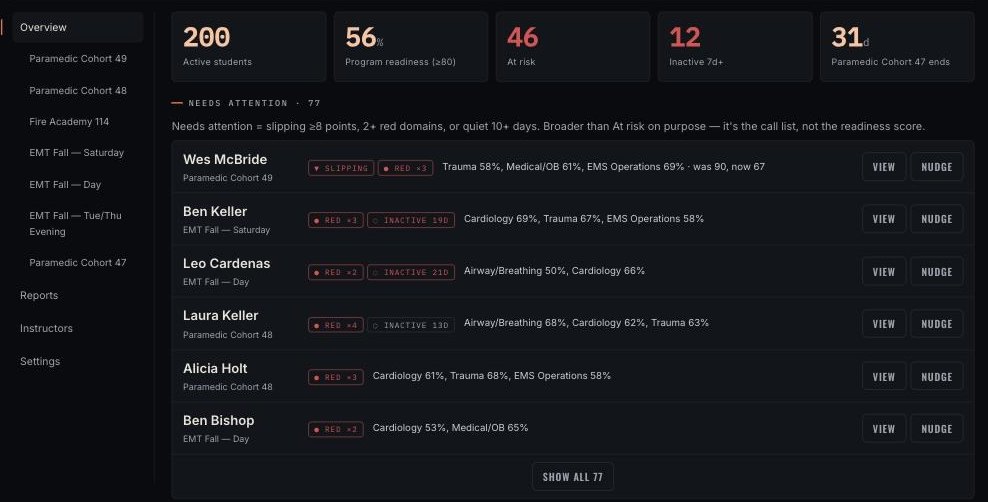
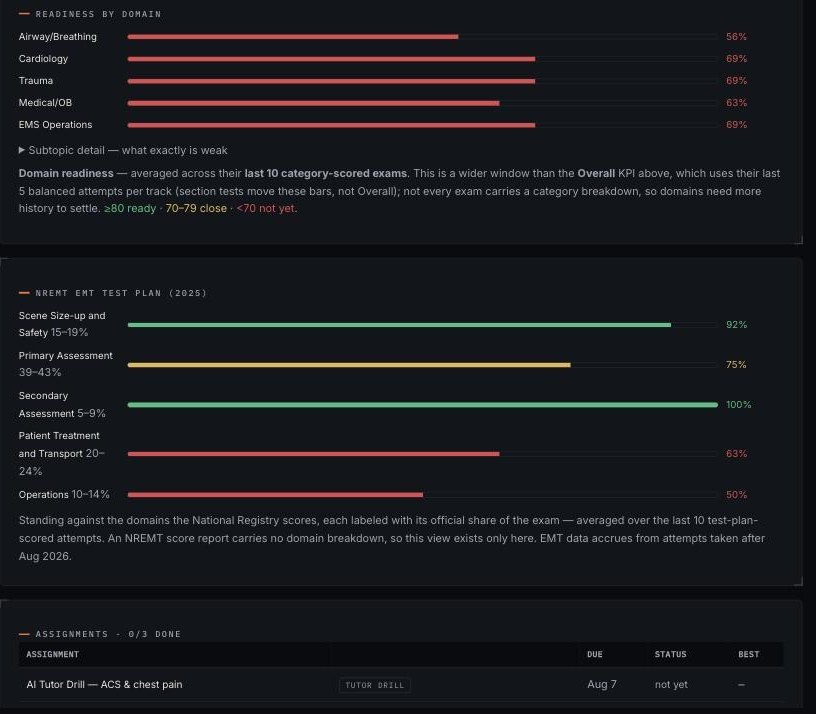
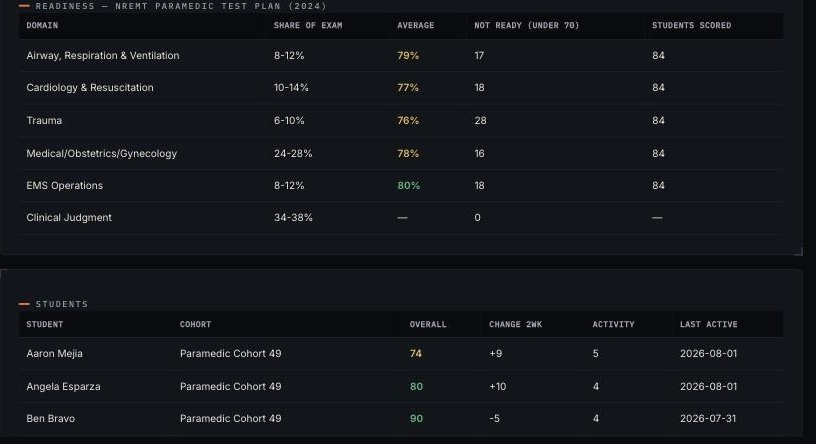
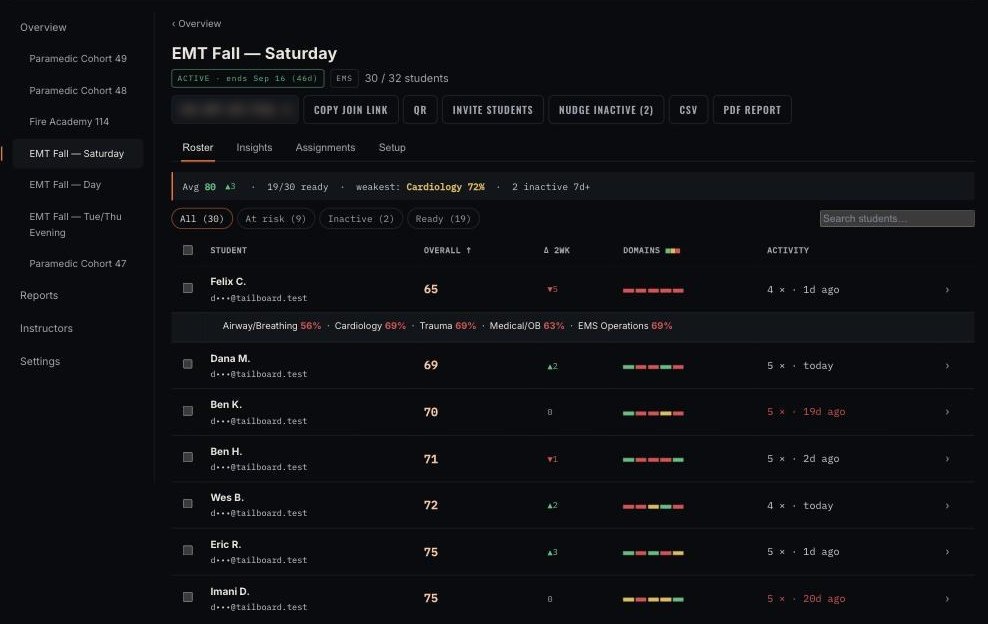
Not a mockup. This is what a director sees on a Monday morning. Two questions get answered: who do I chase, and what do I re-teach.
Every screenshot below is a live console, not a mockup. The program, the rosters and the scores are a seeded demo; the students are generated, not real people. When you do need to hide a real roster, Present Mode masks names and emails on demand.
What your instructors get
- Every score by cohort: exams and oral boards, on one screen, not a spreadsheet you assemble by hand.
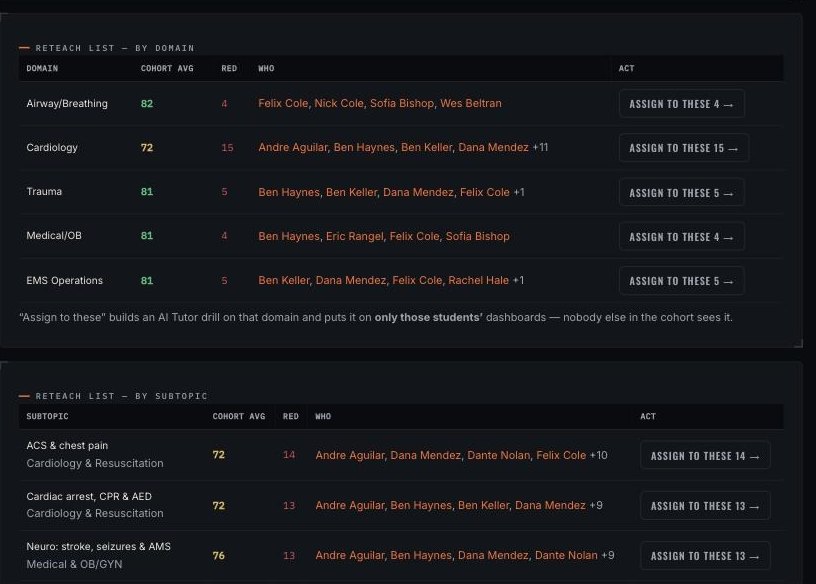
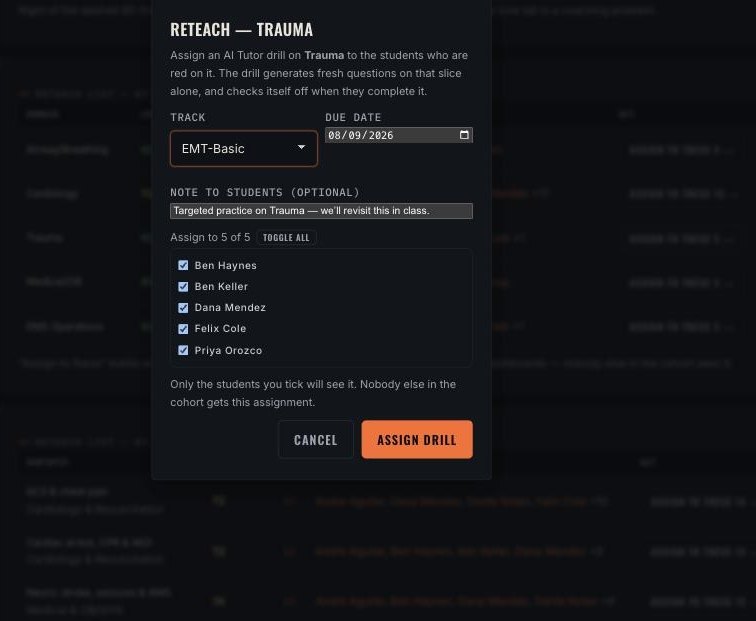
- Reteach lists by domain and subtopic: worst-first, students named, one-click targeted remediation.
- Per-domain readiness: Airway, Cardio, Trauma, Med/OB, Ops. Green, yellow, red.
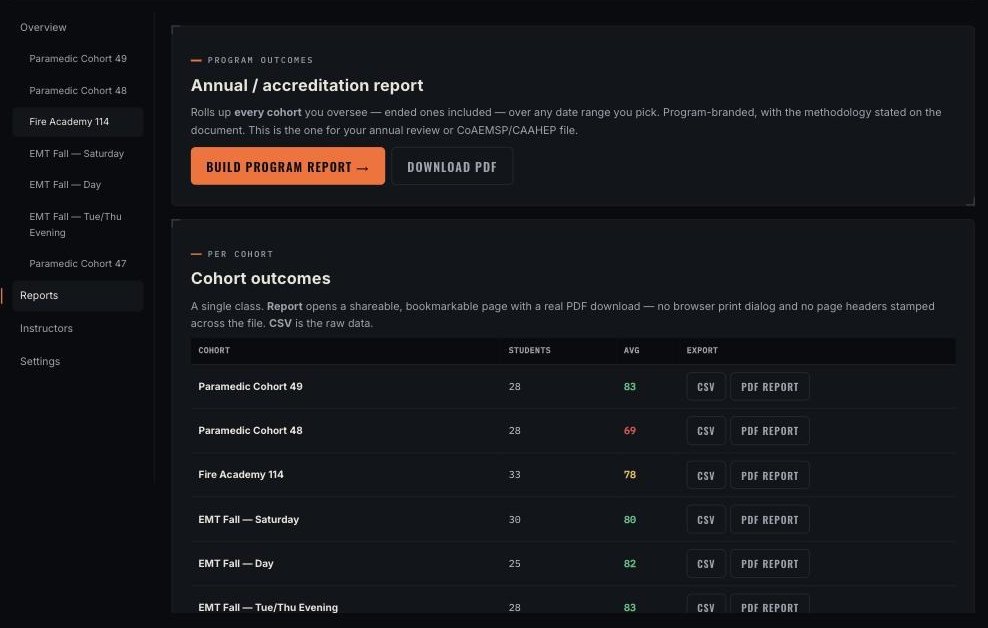
- Program-branded outcomes reports: multi-cohort, date-ranged, ended cohorts included. A real PDF, not a browser print.
- Self-serve cohorts: set caps and dates, assign instructors, invite by email or QR, nudge the quiet ones.
- FERPA controls: one access screen, one-click revocation, an export log, and Present Mode for the projector.
Two more that need a paragraph each
Cross-section teaching insight, directors only. Which topics trail across sections, measured against peer sections in the same exam track, with minimum sample sizes and persistence rules stated on the screen. Measurements, never verdicts: thin data says "not enough data" instead of guessing.
Fifteen minutes a week per student is enough. A 50-question Baseline Diagnostic maps every domain in week one, then one short adaptive Readiness Check (10–25 questions) or a 20-question Weekly Check keeps the early-warning system current. Exam Day, a full Registry simulation at the real exam's length, format and clock, is a once-or-twice-a-term dress rehearsal, not a weekly grind. And drilling a weak topic can never lower a student's readiness number.
What your students get
- The Oral Board Simulator: a live spoken panel that asks real follow-ups and scores the five dimensions real panels use.
- Adaptive + full-length exams: EMT and Paramedic (NREMT-style), plus the firefighter written for fire-track cadets.
- A fully taught question bank: AI tutor, scenarios, Study Hall, EKG and med-math tools. Full access the whole time they're enrolled.
Pricing
Two models, because programs buy two different ways. Same product, same console, same reports: the only difference is which budget line it lands on.
Option A: student-pay (no program budget required)
$0 program license + $59 per student, per term
The way EMS programs already levy testing fees. Nothing to approve, nothing on your budget line. Students pay at enrollment and hold access for the term; the console, the reports and the FERPA controls are identical to the license model. Fee waivers available; tell us how many and we'll cover them.
Option B: program license (nothing billed to students)
An annual license with a pool of concurrent seats: a student holds a seat only while actively enrolled, and seats free up automatically when a cohort ends, so back-to-back classes don't stack.
$1,490 /yr
Up to 30 concurrent seats, one class at a time. About $50 a seat.
$2,900 /yr
Up to 75 seats, multiple concurrent cohorts and instructors. About $39 a seat.
$4,900 /yr
Up to 150 seats, multi-track. About $33 a seat. Larger or district-wide? We'll quote it.
Individual retail access is $179/yr. Every band above is a volume discount against it, and every seat includes the full student product, not a stripped-down school edition.
How this compares
A 24-student EMT cohort, all-in for one year. Incumbent figures are from Platinum Educational Group's published pricing, checked July 2026.
| Model | Program's budget line | Student course fee | Total |
|---|---|---|---|
| Platinum EMSTesting | $500 | 24 × $55 = $1,320 | $1,820 |
| Tailboard (student-pay) | $0 | 24 × $59 = $1,416 | $1,416 |
| Tailboard (Starter license) | $1,490 | $0 | $1,490 |
We publish this because you're going to run the numbers anyway. Platinum has decades of accreditation credibility, clinical and skills tracking, and validation numbers we don't offer. What they don't do is tell you which subtopic to re-teach on Monday and to whom.
See it on your own cohort
Tell us roughly how big your class is and we'll seed a demo console at that size, so you're looking at numbers shaped like yours instead of a generic tour. Usually a reply within one business day.
Prefer email? Write to programs@tailboardacademy.com. We don't sell or share your details. Privacy Policy.
The institutional questions
Everything purchasing, accreditation and compliance will ask, answered in advance, so you can forward this page instead of scheduling three more calls.
Buying this through your business office (PO, net-30, W-9, security review)
Institutions don't pay by credit card off a pricing page. Here's the path from "we want this" to a signed PO, and everything your purchasing and compliance teams will ask for, before they ask.
- Formal quote: seat count, term dates, and total, on letterhead, same week you ask.
- Purchase orders and net-30 invoicing: we invoice against your PO number; the PO and renewal date show inside your console so nobody has to email us to find them.
- W-9 and vendor onboarding: supplied on request, along with a certificate of insurance if your district requires one.
- Security & data-retention summary: where data lives, who can reach it, how long we keep it, and what happens to student records when a cohort ends or you don't renew.
- FERPA addendum: we'll sign yours, or supply ours.
- Accessibility: WCAG 2.1 AA is the target and we test against it. No third-party VPAT yet; if you need one, we'll tell you honestly where we are.
- SSO: on the roadmap, not shipped. If it's a hard requirement for you today, say so on the call and we'll be straight about timing.
Accreditation & outcomes reporting (CoAEMSP / CAAHEP evidence)
Paramedic programs accredited through CAAHEP on the recommendation of the CoAEMSP report student outcomes every year, and assessment data is part of that file. The Tailboard outcomes report is built to be evidence you can put in it:
- Multi-cohort and date-ranged: pull an academic year, not just the class that happens to be running today.
- Ended cohorts included: the only kind an annual review actually examines.
- Your program's name and logo lead the document. Tailboard is the footer.
- Methodology printed on the report: exactly how every number was calculated, so it survives a question in a site visit.
- A real PDF, generated server-side. No browser print dialog, no URL and page numbers stamped across a document going into a binder.
To be clear about what this is: Tailboard is not an accreditor and this report does not replace your CoAEMSP annual report. It supplies assessment-outcomes evidence that goes into it. Confirm current requirements with CoAEMSP directly; standards change, and yours are the ones that matter.
Privacy & FERPA (who can see what, and were students told)
Student scores are visible only to a program's assigned instructors and director, and all cross-student data is service-role protected.
Consent is recorded, not assumed. Before a student can enrol, they're shown a plain-language disclosure of exactly what their instructor and director can see (scores, results, which topics they drill, when they were last active), and they have to tick it. We store that acknowledgment together with the version of the text they saw. If the wording ever changes, you can see precisely which students acknowledged which version instead of guessing. Declining leaves them with an ordinary free account; nobody is enrolled silently.
- One screen showing everyone with access: who they are, which cohorts they can see, and one-click revocation.
- An export log: who downloaded or exported student data, and when. This is what turns a FERPA claim into evidence.
- Consent coverage for your roster: how many students acknowledged, on which version.
- Present mode: masks student names and emails on screen when you project the roster in class. Exports and reports are unaffected.
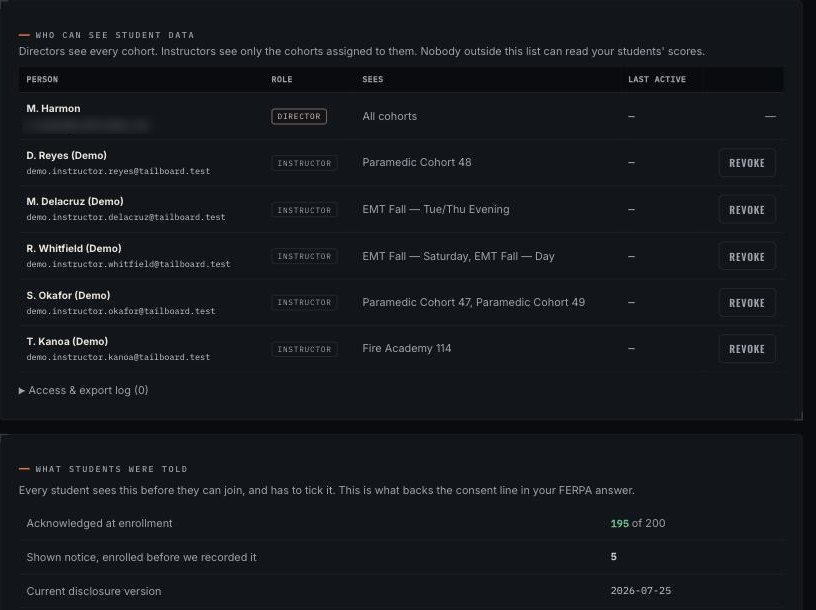
So "who can see my students' records, and were they told?" is a question you answer yourself, in one screen, without emailing us. We're glad to walk your compliance team through the data model, and we'll sign your FERPA addendum or supply ours.
Frequently asked questions
How does pricing work, and can students pay their own fee?
Two ways, because programs buy two different ways. (1) A program license: an annual fee with a pool of concurrent seats, paid from the program's budget: $1,490, $2,900, or $4,900/yr by size. (2) Student-pay: no license fee at all, and each student pays a $59 course fee for the term, exactly the way EMS programs already levy testing fees. The console, the outcomes reports and the FERPA controls are identical either way. Most programs that already charge a course fee find student-pay clears their business office faster, because it lands on a line item that's already approved.
How does that compare to what we pay now?
For a 24-student EMT cohort: the incumbent's model is a $500 school license plus $55 per student billed to the student, about $1,820 all-in. Tailboard student-pay is $0 to the program and $59 per student, about $1,416 all-in. A Tailboard program license is $1,490 with nothing billed to students. We publish this comparison because you're going to run the numbers anyway.
Does this help with CoAEMSP / CAAHEP reporting?
That's what the outcomes report is built for. It rolls up multiple cohorts over any date range, including cohorts that have already ended, which is the only kind an annual review examines, and states its methodology on the document so the numbers can be defended in a site visit. It carries YOUR program's name and logo; Tailboard is the footer. We are not an accreditor and the report doesn't replace your CoAEMSP annual report; it gives you the assessment-outcomes evidence that goes into it.
What can instructors see?
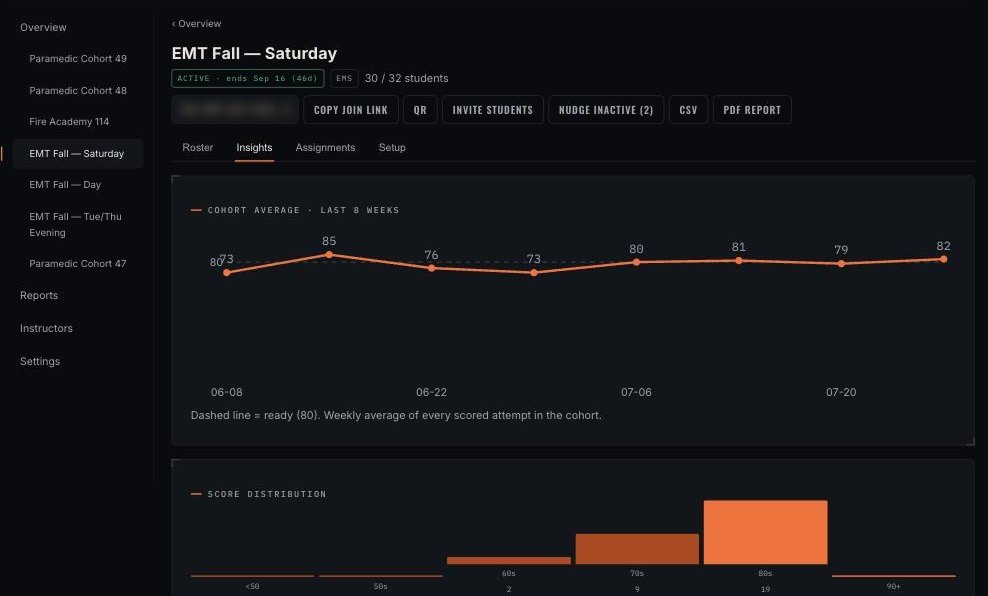
By cohort: each student's exam and oral-board scores, per-domain readiness (Airway, Cardio, Trauma, Med/OB, Ops), an at-a-glance 'ready' signal, activity recency, an 8-week cohort trend, and a reteach list that names the exact weak subtopic and the exact students failing it, with a button to assign remediation to just those students. Directors see every cohort; instructors see only the cohorts assigned to them. Students are told at enrollment that their instructor can see their scores.
How do students join?
You send a class link, code, or QR. Students create a free account through it and are enrolled automatically with full access for as long as they're in your cohort, no cards, no per-student setup. You can also paste a roster of emails and we invite them for you.
Can we pay by purchase order?
Yes. We invoice institutions net-30 against a PO, and can supply a W-9, a formal quote, a security and data-retention summary, and a signed FERPA addendum before you raise the requisition. Email programs@tailboardacademy.com and tell us the seat count and start date; a quote comes back the same week.
Is there a pilot?
Yes, one cohort, one term, free. Your team sees the roster, the readiness data and the outcomes report on your own students before any money moves. We ask for one thing in return: a 20-minute debrief at the end, whether you buy or not.
Is this FERPA-compliant?
Scores are visible only to the program's assigned instructors and director, and all cross-student access is service-role protected. Students see a plain-language disclosure of exactly what their instructor can see and must tick it before they can enroll, and we store that acknowledgment with the version of the text they saw, so you can evidence it rather than assert it. Directors get one screen listing everyone with access, one-click revocation, an export log, and the consent coverage for their roster. We're happy to walk your compliance team through the data model, and we'll sign your FERPA addendum or supply ours.
Do you support SSO and LMS integration?
Not yet, and we'd rather say so than imply otherwise. SSO (SAML/Google Workspace) is on the roadmap for programs that require it, and LTI/rostering is behind that. If SSO is a hard procurement requirement for you today, tell us on the demo call. It moves our priorities and we'll be straight with you about timing.
What about accessibility?
The console and student app are keyboard-navigable with semantic markup and text alternatives, and we test against WCAG 2.1 AA. We have not completed a third-party VPAT yet; if your institution requires one, say so and we'll tell you honestly where we are rather than send you a checkbox.
Built by a working Firefighter/Paramedic and former U.S. Navy SAR medic. NREMT- and FCTC-style practice; not affiliated with or endorsed by the NREMT, FCTC, CoAEMSP, CAAHEP, or any department. Training tool; no exam, certification, or employment outcome is guaranteed. Competitor pricing shown is from publicly published vendor pricing pages, checked July 2026, and may change.