The Firefighter Written Exam: What's Actually on It and How to Study
The written exam is the first scored gate of the hiring process, and it's the one candidates most consistently under-prepare for — usually because they assume "general aptitude" means "can't study for it." Wrong on both counts. Firefighter writtens test a stable, predictable set of skills, and practice moves scores substantially, because half the battle is familiarity with the question formats under time pressure.
No firefighting knowledge is required or expected on most entry-level writtens. What's tested is whether you can read carefully, compute quickly, reason mechanically, remember what you saw, and choose sensibly in human situations — the raw materials of a trainable firefighter.
What's on the test
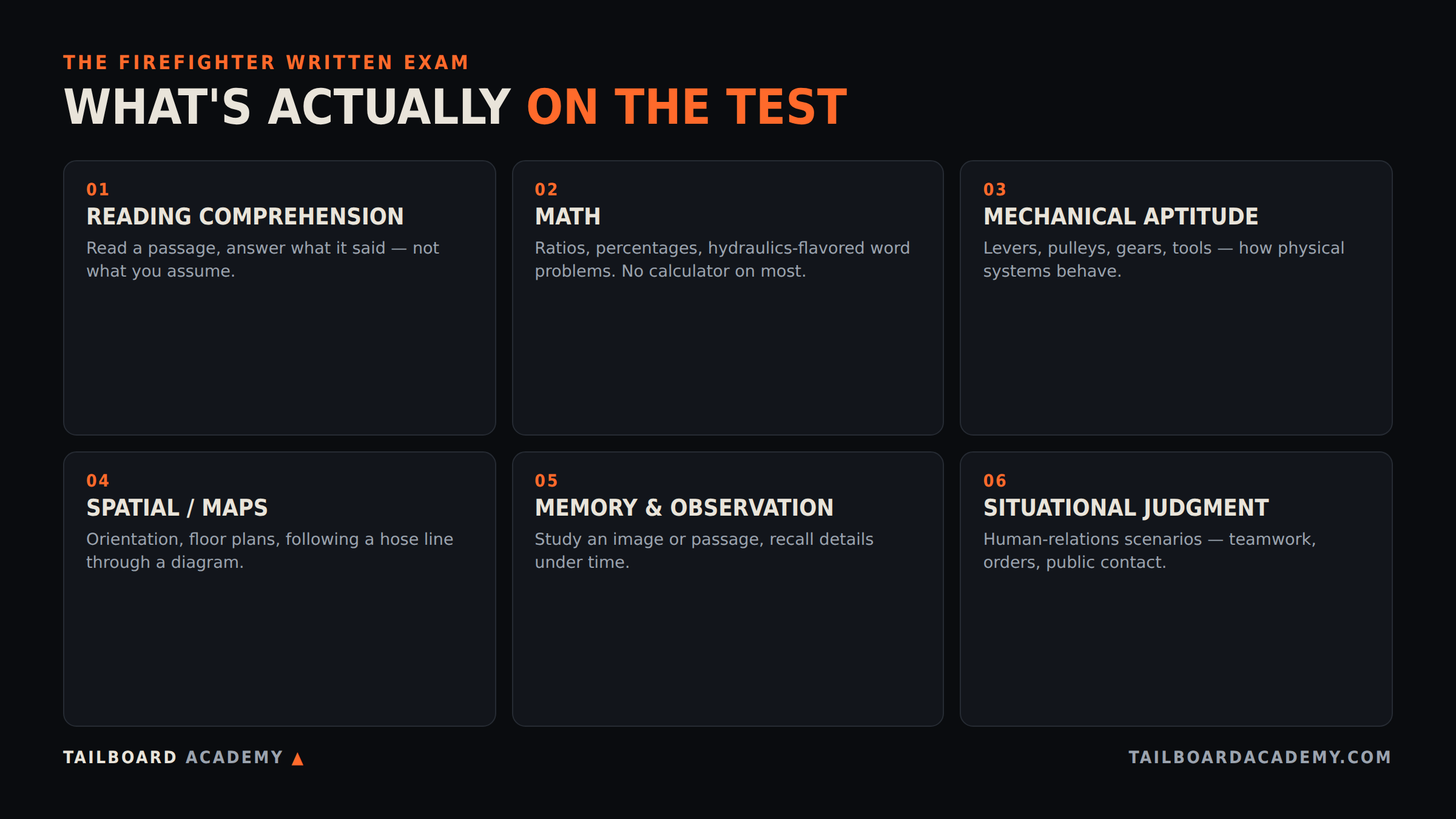
Reading comprehension. Passages — often procedure or policy-flavored — followed by questions about what was stated, not what you'd assume. The classic trap is answering from common sense instead of the text.
Math. Arithmetic, ratios, percentages, unit conversions, and word problems that smell like the fireground: hose lengths, flow rates, elapsed times. Calculators are usually prohibited; pencil arithmetic speed is trainable and worth training.
Mechanical aptitude. Levers, pulleys, gears, valves, tools, and simple machines — which way does gear B turn, which arrangement lifts with less force. If it's been a decade since you thought about mechanical advantage, this section is the highest-yield place to study.
Spatial orientation and maps. Following a route through a floor plan, orienting from a map, visualizing an object rotated. Practice makes these fast; unfamiliarity makes them time sinks.
Memory and observation. Study an image or a passage for a fixed period, then answer questions from recall. There's a technique layer here — systematic scanning beats staring — that only practice builds.
Situational judgment / human relations. Workplace scenarios: orders you disagree with, coworker friction, public interactions. Pick the answer that's safe, honest, respectful of the chain of command, and team-first — the same instincts that later win oral boards.
In California, much of this arrives via the FCTC statewide written; other agencies use National Testing Network's FireTEAM (which adds a video-based human-relations format) or in-house exams. Formats differ; the skill list barely does. Where the exam sits in the larger sequence is covered in the California hiring pipeline.
How scores are used — and why "passing" isn't the goal
Most departments don't just pass/fail the written; they rank with it, band it, or use it as a multiplier alongside the oral board. A 90 doesn't just clear the bar a 71 clears — it can mean hundreds of positions on a big list. Study like the score counts, because it usually does.
A 4-week study plan
Week 1 — Diagnose. Take one full-length practice exam, timed and calculator-free. Score by section. Your two weakest sections get 60% of your remaining study time.
Week 2 — Drill weaknesses. Mechanical aptitude and math respond fastest to focused work: 30 minutes a day of section drills beats untargeted full tests. For reading, practice underlining what the question actually asks before touching the choices.
Week 3 — Build speed. Timed section sprints. Most writtens are lost to pacing, not knowledge — learn your per-question budget and practice abandoning time sinks (mark, move on, return).
Week 4 — Simulate. Two full timed exams under test conditions, reviewing every miss to its root cause. Tailboard Academy's practice tests are built for exactly this loop — timed, scored, and explained, so a wrong answer teaches instead of just stinging.
Reading about the written is step one. Sitting one under a clock is the rest. Tailboard scores full-length practice by category, so you find out which section is costing you the points.
Run a free scored test, no card → Take the 20-question check first
The bigger picture
The written gets you onto the field; it rarely wins the game. In most California processes, candidates who clear the written arrive at the oral board where the actual ranking happens — which is why my honest advice is to study for the written in focused weeks and give the board the long runway. Tailboard covers both ends: adaptive practice exams for this gate, and the Oral Board Simulator — three voiced panelists, live follow-ups, written after-actions — for the gate that ranks you.
FAQ
How hard is the firefighter written exam? Content sits around a solid high-school level. The difficulty is time pressure and format unfamiliarity — both of which practice removes. Unprepared candidates fail writtens they'd pass comfortably with two weeks of drills.
What score do I need? Passing thresholds commonly sit near 70%, but hiring realistically requires much higher when scores feed rankings. Aim for 90+ and you stop worrying about cutoffs.
Can I use a calculator? Usually no. Practice pencil-and-paper arithmetic — it's a speed skill that fades and returns quickly.
How is the FCTC written different from NTN FireTEAM? FCTC is a traditional multiple-choice exam feeding California's statewide list; FireTEAM leans on video-based human-relations scenarios plus reading, math, and mechanical sections. Serious California candidates often take both, since departments split between them.
Do I need to know fire behavior or department procedures? Not for entry-level writtens — everything needed is provided in the questions. Job knowledge starts mattering at the academy, not the exam.
Practice the way it's scored. Tailboard Academy's timed practice exams diagnose your weak sections and explain every answer — and when the written's behind you, the Oral Board Simulator is waiting. Built by a working SoCal firefighter/paramedic. Run a free board — no card.
By John — active Southern California firefighter/paramedic. He went through this hiring process himself and built Tailboard Academy's Oral Board Simulator: three voiced panelists, live follow-up questions, and a written after-action after every session.