Failed the NREMT? Your score report can't tell you where you're weak.
If you didn't pass, you got one scaled score on a 100–1500 scale, a passing point of 950, and a graphic showing how far you were from the standard. What you didn't get is a domain breakdown; the old “above / near / below passing standard” report by subject area is gone.
“Our system scores the certification examination as a whole.”
Source: current NREMT candidate handbook
So the score tells you how far. It cannot tell you where. Retest Recovery closes that gap: a free baseline diagnostic, drawn to the real exam blueprint's domain weights, EMT or Paramedic, finds where you're actually weak, and your score sets how hard the plan pushes. Out comes a day-by-day rebuild plan sized to the 15-day window the NREMT already makes you wait.
Entering your score is optional; without it, the plan is built purely from the diagnostic.
How it works
- Intake. Attempt number, exam date, level (EMT or Paramedic), and, optionally, your scaled score. We never ask you to upload your score report, and we never store it.
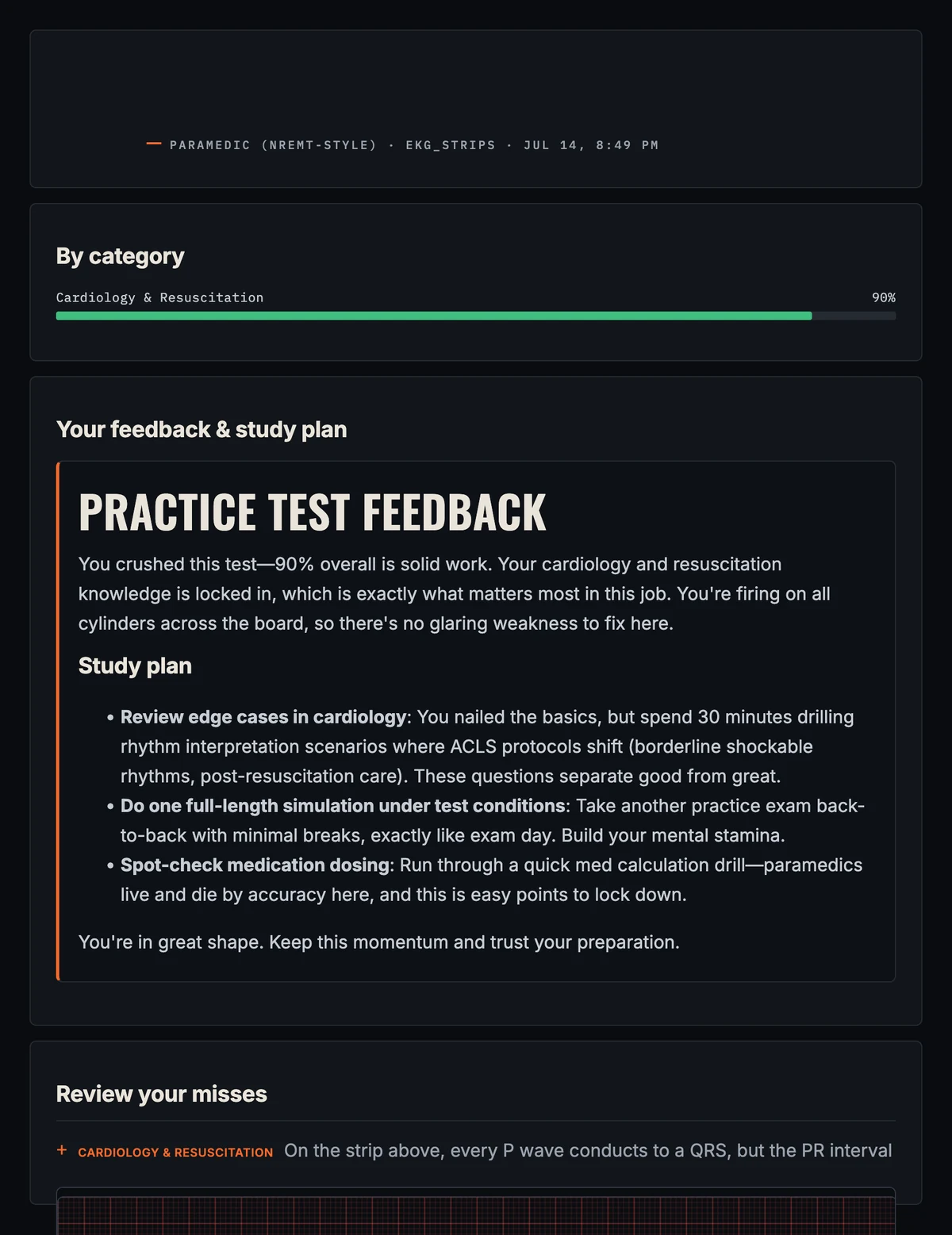
- Day 1: baseline diagnostic (free). Questions are drawn by exam blueprint weight, so the proportions match the real test, not whatever happens to be convenient. This is what replaces the domain breakdown your report no longer gives you.
- Targeted drills. Daily blocks weighted toward the domains the diagnostic exposed, spaced so you never grind the same domain two days in a row, and every domain still gets at least a small block even if you aced it.
- Full-length timed simulation. The day before your last review day: one sitting, no pausing, no notes. Sit it like the real thing.
- Final day: light review only. Missed questions only, never new material the day before a retest, plus a readiness estimate: 70% academic performance, 30% plan adherence. It's our internal estimate of preparation, not a prediction of your result.
Your score sets the intensity
One scaled score can't locate your weakness, but it does measure distance, so it sets how many hours a day the plan asks for.
| Scaled score | Where you stand | Plan |
|---|---|---|
| 900–949 | You were close. | 15 days · 1 hr/day |
| 820–899 | A real but closable gap. | 15 days · 1.5 hr/day |
| 700–819 | More than polish. | 15 days · 2 hr/day |
| 100–699 | Foundation first; give this more than 15 days. | 30 days · 2 hr/day |
| No score entered | We'll work from your diagnostic instead. | 15 days · 1.5 hr/day |
Enter 950 or above and the intake will stop you: that's a pass, and you don't need this.
Why 15 days
You can reapply and pay the moment your result posts, but the NREMT requires you to wait 15 days from your last exam date before testing again, and you get six total attempts. Those 15 days are either a structured rebuild or two weeks of re-reading the same chapters that didn't work the first time. The plan exists to make them the first thing.
EMT cognitive exam: computer adaptive, 70–120 items, 2 hours, $104 per attempt. Paramedic: computer adaptive, 110–150 items, 3.5 hours, $175 per attempt (one exam; there has been no separate ALS psychomotor exam since July 1, 2024).
Frequently asked
Can't you just read my score report and tell me my weak domains?
No, and neither can anyone else, because the information isn't in the report anymore. The exam is scored as a whole. Anyone promising to decode your report's domain breakdown is describing a document that no longer exists. Our diagnostic replaces it: blueprint-weighted questions, scored per domain, free.
What happens to my score report if I use it during intake?
It never leaves your device. The intake reads the PDF or screenshot locally in your browser so you can read the number off it while typing; the file is never uploaded, transmitted, or stored. Our database holds an integer, a level, an attempt number, and dates. That's it.
Is the readiness number my chance of passing?
No. It's Tailboard's internal estimate of your preparation, 70% academic, 30% adherence. It is not a pass probability, and no exam outcome is guaranteed by anyone, including us.
I've failed three times. Does this satisfy the remedial education requirement?
No. After three unsuccessful attempts, the National Registry requires accredited remedial education documented with your fourth-attempt application. Tailboard Academy is not accredited continuing education and does not satisfy that requirement, and some states won't accept CE in place of a traditional refresher at all. Contact your State EMS Office before you spend money on anything, including us.
EMT and Paramedic?
Both, each weighted to its current blueprint. On the EMT exam, Primary Assessment alone is 39–43% of scored items, roughly four in ten, more than Scene Size-Up, Secondary Assessment, and Operations combined. On the Paramedic exam, Clinical Judgment is 34–38%. If your prep last time treated every topic equally, that's a plausible part of what went wrong.
Where is it in the app?
More → Learn → NREMT Retest Recovery, or go straight to tailboardacademy.com/retest.
NREMT® is a registered trademark of the National Registry of Emergency Medical Technicians. Tailboard Academy is not affiliated with or endorsed by the NREMT. Practice questions are original study material, not actual exam content. The readiness estimate is Tailboard's internal estimate of preparation, not a prediction of any exam result. No pass, score improvement, or certification outcome is guaranteed. Retest Recovery is not accredited continuing education and does not satisfy the National Registry's remedial education requirement after three attempts.