Firefighter Situational & Ethical Interview Questions: The No-Win Scenarios That Have a Right Answer
"Your best friend on the crew shows up smelling of alcohol." "Your captain orders something unsafe." "You see a firefighter pocket cash on a medical call." These questions feel like traps — every option seems to cost you something. They're not traps. They're the most predictable, most learnable questions on the board, because they all reward the same ordered response: protect life safety, address the immediate problem, use the chain of command, and follow up with complete honesty.
Panels lean on scenarios because your polished answers can be rehearsed, but your priorities leak out under pressure. This guide covers the scenarios that appear over and over, the skeleton that organizes every answer, and the traps that actually cost points.
The skeleton
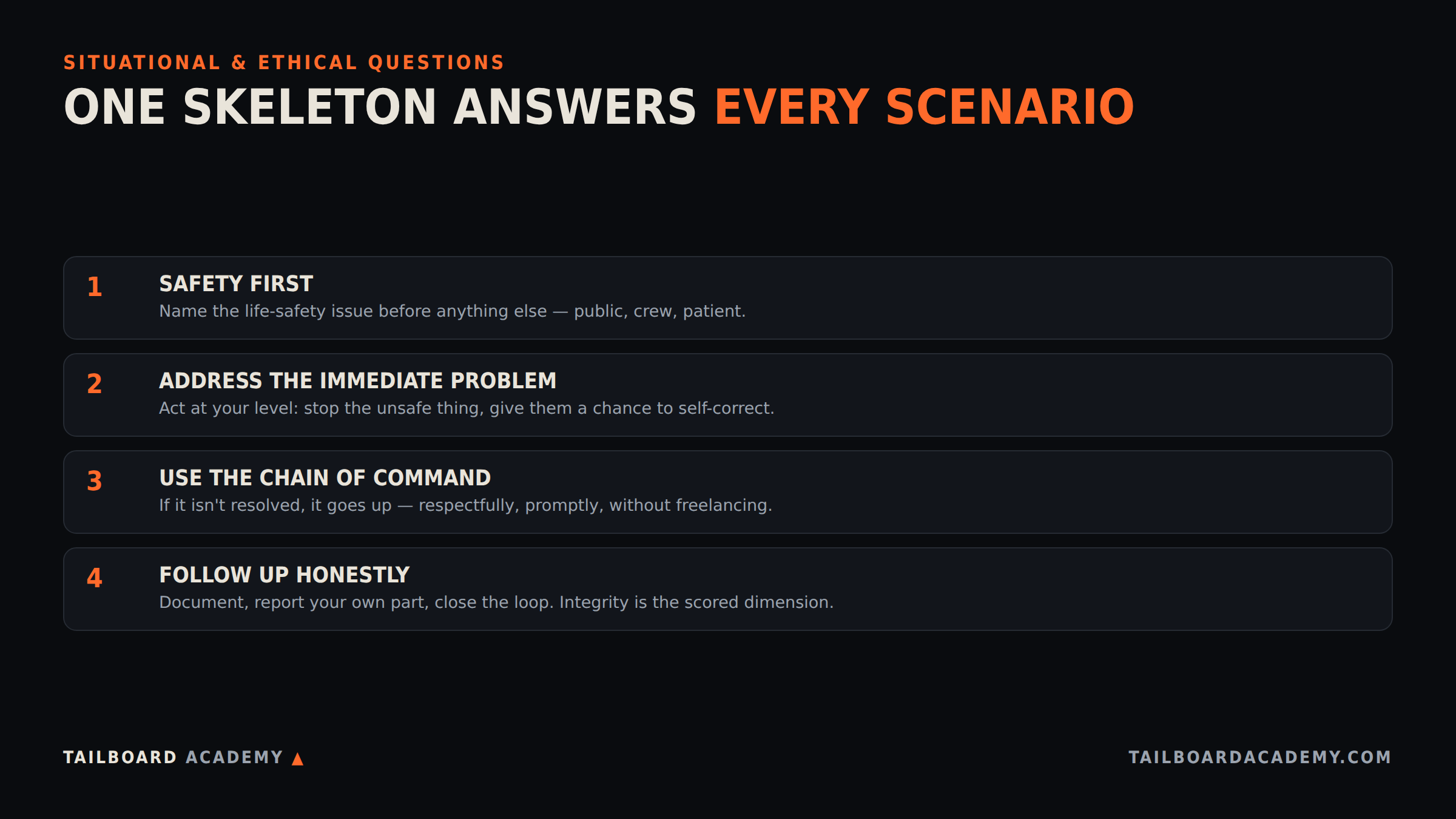
Every situational answer should walk the same four steps, out loud, in order:
1. Safety first. Name the life-safety issue before anything else. An impaired partner can kill a patient or a crew member; an unsafe order can kill you. Raters listen for whether safety leads your thinking or trails it.
2. Address the immediate problem at your level. Stop the unsafe thing from happening. Give the person a chance to self-correct — pull your partner aside, voice your concern to the captain respectfully. This shows you act rather than just report.
3. Chain of command. If it isn't resolved at your level, it goes up — promptly, respectfully, without freelancing or covering. Probationary firefighters aren't expected to fix everything; they're expected to escalate correctly.
4. Follow up honestly. Document, report your own role, close the loop. This is where the integrity dimension gets scored — see how boards score answers for why this step carries weight beyond the scenario itself.
Say the steps in order even when the answer feels obvious. The rubric rewards the ordered walk-through, not the conclusion alone.
The classic scenarios, walked through
The impaired partner. The scenario everyone gets, in some form. Walk it: the safety issue is that they cannot respond to calls. Immediately and privately, tell them what you observe and that they can't work like this — give them the chance to take themselves out of service. If they refuse, you inform the company officer before the next call drops. In your close, acknowledge the human side: you'd want them to get help, and you'd want the same intervention if it were you. What fails candidates here is hedging — "I'd keep an eye on them" ends candidacies.
The unsafe order. Respect and safety aren't in conflict: you voice the concern once, clearly ("Cap, that light's red and we're non-emergent"). If it's a matter of law or life safety, you don't comply; you address it through the chain afterward. If it's merely a technique disagreement, you comply and ask about it later. Show you know the difference — that distinction is the answer.
Theft on scene. No warning, no loyalty discount. It goes to your officer immediately. Theft on a call is a crime against someone at their most vulnerable, and any hesitation reads as negotiable integrity.
The mistake nobody saw. You report it — every time, in full. Panels ask this because fireground culture runs on self-reporting; hidden errors compound into dead firefighters and lawsuits. Bonus points for saying what you'd do next: document, tell your officer, identify what you'll change.
Conflict with a senior firefighter. Direct and private first, chain of command only if behavior affects safety or the crew. Show you can be told you're wrong, too — humility scores.
The harassment scenario. Modern boards increasingly ask it. Safe intervention if possible, unambiguous refusal to participate, documentation, chain of command. "That's just firehouse culture" is an automatic fail.
The traps that actually cost points
Three patterns sink situational answers. Hedging — soft-pedaling the intervention to preserve the friendship; panels read it as exactly what you'd do on shift. Vigilante mode — handling everything yourself with no escalation; probies who freelance scare officers. Speech-making — reciting values ("integrity is my core value") instead of walking steps. The skeleton exists precisely because concrete beats abstract on a scoresheet.
When I prepped for my own boards, scenario questions were the ones that rattled me most — not because I didn't know right from wrong, but because saying the steps cleanly under pressure is a skill of its own. It's why the panelists in Tailboard Academy's Oral Board Simulator press live follow-ups on scenario answers ("And if he begs you not to report it?") — the follow-up is where real boards find out if your first answer was conviction or script.
Reading about the oral board is step one. Sitting one is the rest. Tailboard runs a live panel that asks real follow-ups and scores you like a real board. Run one free, no card.
Rehearse the pressure, not just the answer
Run the scenarios above out loud, then have someone push back on each answer — or run them against Tailboard's Oral Board Simulator, which follows up the way panels do and scores the answer across a written rubric. Then round out your prep with the full list of 25 board questions.
FAQ
Is there really a "right answer" to ethical questions? For the core of it, yes: safety over comfort, honesty over loyalty, chain of command over freelancing. Where candidates differentiate is in the delivery — ordered steps, human empathy, and holding firm under follow-up.
What if I'd genuinely give my friend a second chance? The scenario is measuring whether the public's safety outranks your friendships. You can be humane — give them the chance to self-report, support them afterward — but the line "they don't work this shift" has to be non-negotiable in your answer.
Should I mention specific policies or laws? Lightly. Naming that impaired driving is illegal or that departments have substance-abuse policies shows awareness. Reciting statute numbers reads as rehearsed trivia.
What if I've never faced anything like these situations? That's expected for entry-level. Panels aren't scoring your history; they're scoring your priorities and reasoning under pressure. The skeleton gives you both.
How long should a situational answer run? Sixty to ninety seconds for the walk-through, then stop. Leave room for the follow-up — it's usually coming, and handling it calmly scores as high as the original answer.
The follow-up is the real test. Tailboard Academy's Oral Board Simulator asks the scenario, then presses back the way real panels do — three voiced panelists, live follow-ups, a written after-action every session. Built by a working SoCal firefighter/paramedic. Run a free board — no card.
By John — active Southern California firefighter/paramedic. He went through this hiring process himself and built Tailboard Academy's Oral Board Simulator: three voiced panelists, live follow-up questions, and a written after-action after every session.