12 Oral Board Mistakes That Fail Good Candidates
Most people who bomb an oral board don't bomb it for lack of virtue or preparation hours. They bomb it on unforced errors — patterns raters see a dozen times a day and score down on reflex. Here are the twelve that do the most damage, roughly in order of how often they end candidacies, and the fix for each.
The big six
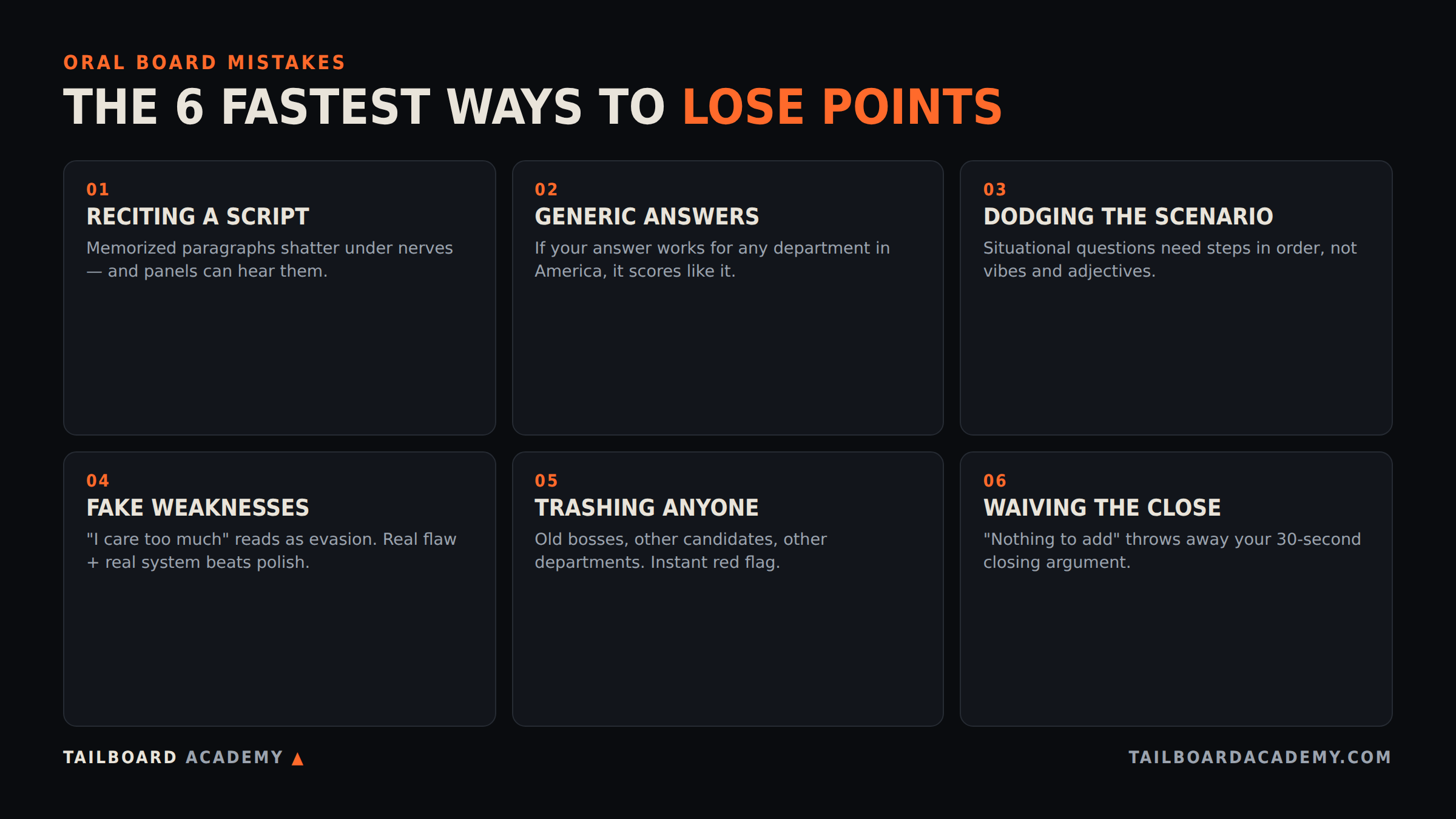
1. Reciting a memorized script. A written-then-memorized answer has a cadence every rater recognizes, and it shatters the moment a follow-up knocks you off the page. Fix: rehearse shapes, not scripts — bullet-point frameworks you can flex, practiced out loud until the transitions are yours.
2. Generic answers. If your "why this department" works for any department in America, it scores like it. Fix: five concrete facts about the agency — staffing, call volume, programs, community — and weave two of them in naturally.
3. Dodging the scenario. Answering situational questions with values instead of steps ("I'd handle it with integrity") is a non-answer. Fix: the four-step skeleton — safety, immediate action, chain of command, honest follow-up — walked out loud, in order.
4. The fake weakness. "I'm a perfectionist" and "I care too much" read as evasion, and evasion bleeds into the integrity dimension. Fix: a real weakness plus the specific system you use to manage it.
5. Trashing anyone. Old bosses, former coworkers, other departments, other candidates. Every disparagement is scored as a preview of how you'll talk in the firehouse. Fix: neutral framing, always — "we saw it differently, and here's how I handled it."
6. Waiving the close. "No, nothing to add" throws away a scored 30-second closing argument. Fix: a prepared close — recap your preparation, state you want this job at this department, thank the panel by role.
The other six
7. Talking too long. Nerves stretch answers, and long answers bury the scoreable content. Practice with a timer; most answers land in sixty to ninety seconds.
8. Answering the question you wished they'd asked. Raters score against the question on the script. Listen fully, pause a beat, answer that. If you're unsure, asking for a repeat costs nothing — see how the scoring works.
9. First-impression neglect. Wrinkled shirt, limp handshake where offered, slouching, dead eye contact. "Overall impression" is on most scoresheets, and it's set in the first ninety seconds.
10. Zero questions... about the wrong things. If invited to ask questions, asking about salary or schedule flags your motivation. One thoughtful question about training or expectations — or a gracious "you've covered it; I'm ready to close" — both work.
11. Inconsistency with your paperwork. The panel may have your application; the chief and background investigator certainly will. A story that shifts between tellings becomes an integrity problem later. One set of true facts, every time.
12. Practicing silently. The most common mistake of all, and the least visible. Reading answers in your head trains recognition, not delivery. The first time your answers leave your mouth cannot be in the room where they're scored.
Why good candidates make these mistakes
Because nothing in normal life rehearses this format: a scripted panel, a rubric, a clock, and stakes. The errors above aren't character flaws — they're what unrehearsed delivery looks like under adrenaline. Which means the fix is unglamorous and completely reliable: spoken reps under something that resembles pressure.
That's the gap I built Tailboard Academy's Oral Board Simulator to close. Three voiced panelists run you through real board questions with live follow-ups — the exact conditions where these twelve mistakes surface — and the written after-action names which ones showed up, so your next rep targets something specific.
Reading about the oral board is step one. Sitting one is the rest. Tailboard runs a live panel that asks real follow-ups and scores you like a real board. Run one free, no card.
Run your own audit
Record yourself answering five questions from the 25-question list, then play it back against this list — or let Tailboard's Oral Board Simulator do the audit and hand you the after-action. Either way: find your two habitual mistakes and drill those. Nobody makes all twelve; almost everybody makes two.
FAQ
What's the single most common mistake? Practicing silently. It's upstream of half the list — scripts, rambling, shaky delivery all trace back to answers that never got spoken before they got scored.
Can one bad answer fail the whole board? Usually no — except integrity questions, where a hedge or a cover-up answer can sink an otherwise strong interview at many agencies.
Is it a mistake to pause before answering? No — a deliberate two-second pause reads as composure. Filling that pause with "um, that's a great question" on every question, though, becomes a tic raters notice.
Should I admit when I don't know something? Yes, cleanly: "I don't know, and here's how I'd find out." Bluffing in front of people who do this job for a living is unrecoverable.
How many mock interviews before the real one? Until follow-ups stop rattling you — for most people that's somewhere between five and fifteen full spoken run-throughs, not one the night before.
Find your two mistakes before the panel does. Tailboard Academy's Oral Board Simulator surfaces them under real follow-up pressure and names them in a written after-action. Built by a working SoCal firefighter/paramedic. Run a free board — no card.
By John — active Southern California firefighter/paramedic. He went through this hiring process himself and built Tailboard Academy's Oral Board Simulator: three voiced panelists, live follow-up questions, and a written after-action after every session.