
Firefighter Background Check and Psych Eval: What to Expect (and What Actually Disqualifies)
The conditional offer isn't the finish line — it's the start of the most invasive stage of the process: a background investigation and psychological evaluation that will touch nearly everything you've done as an adult. Here's the reassuring part most candidates don't hear: background investigations rarely fail people for their history. They fail people for lying about their history. Understand what's checked, disclose completely, and this stage is mostly patience.
One important caveat up front: standards vary by department and state, and none of this is legal advice — for questions about your specific record (expungements, juvenile matters, out-of-state issues), talk to the department's background unit or a lawyer. What follows is the common shape of the process.
What they actually check
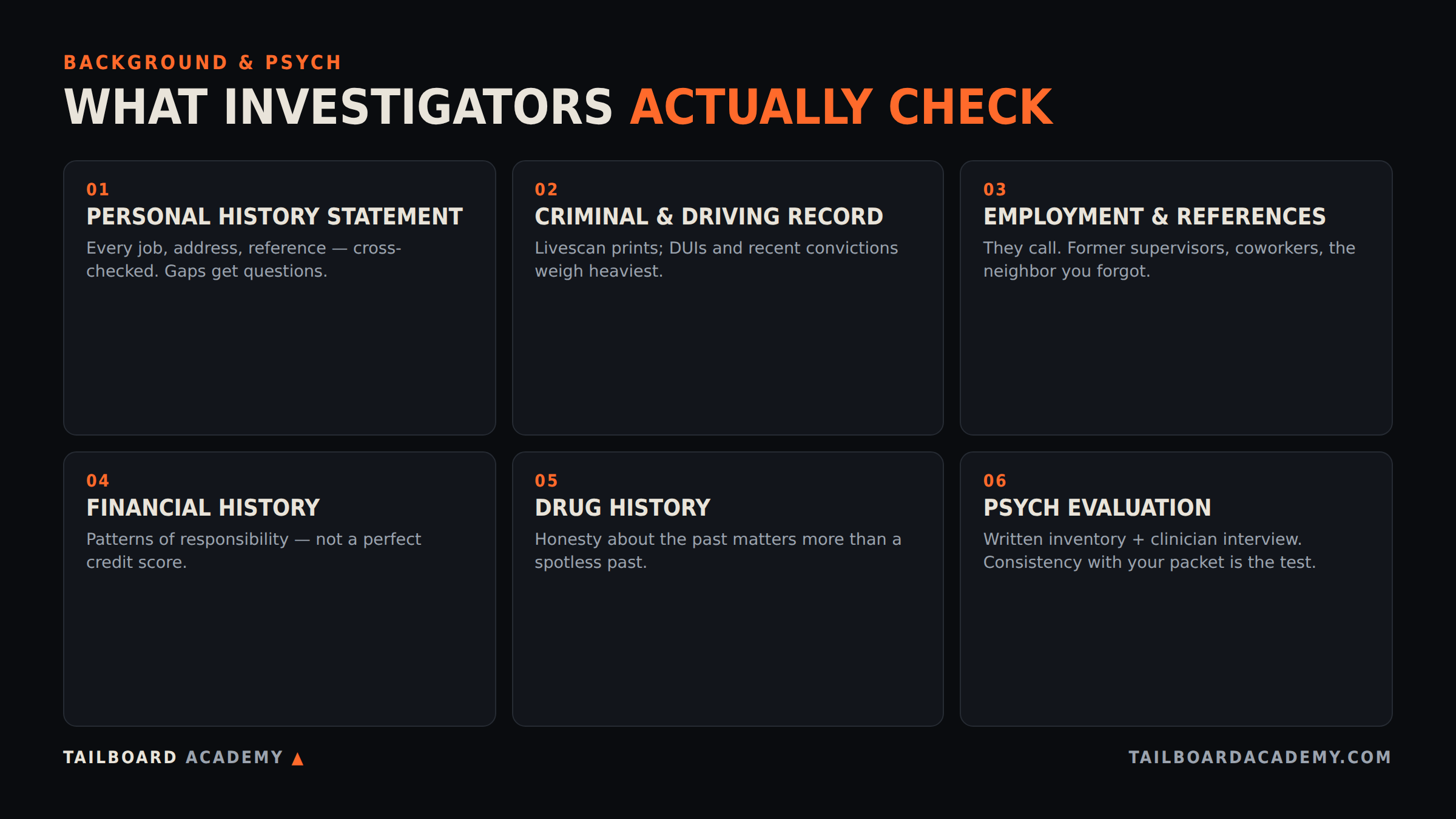
The personal history statement. A packet — often dozens of pages — covering every job, address, school, reference, and significant relationship, sometimes back to age 18 or further. Investigators cross-check it against records and interviews. Gaps and inconsistencies generate follow-ups; contradictions generate problems.
Criminal and driving record. Fingerprint-based checks (Livescan in California) pull everything, including things you assumed were invisible. Driving matters more than candidates expect — you'll be trusted with a 40,000-pound apparatus, and a pattern of recent violations or a fresh DUI weighs heavily.
Employment and references. They call — supervisors, coworkers, the references you listed, and often people you didn't. Leaving a job off the packet because it ended badly is the classic self-inflicted wound; the investigator finds it anyway, and now the issue is concealment.
Financial history. Not a credit-score contest — a responsibility pattern check. Collections and past struggles with a recovery arc read fine; active chaos and unexplained debts invite questions.
Drug history. Departments differ on lookback windows and what's disqualifying, and marijuana standards have loosened in many jurisdictions. What hasn't loosened anywhere: honesty. The disclosure form is a truthfulness test wearing a drug-history costume.
The psych evaluation. Typically a long written inventory (hundreds of true/false-style items) followed by an interview with a psychologist. It screens for suitability for a high-stress public-safety role — it is not a trick, and trying to game it produces exactly the inconsistency it's designed to catch. Answer straight; consistency between your packet, your interviews, and your inventory is the real metric.
What actually disqualifies
Patterns, recency, and dishonesty — roughly in reverse order of survivability. Recent DUIs, undisclosed arrests, fabricated employment history, and lies discovered mid-process end candidacies at most departments. Older mistakes, disclosed fully and framed with what changed, survive far more often than the anxiety around them suggests: plenty of working firefighters have a rough chapter in their packet. The unforgivable version of any offense is the concealed version.
This is also why consistency across the whole process matters so much: your board answers, chief's interview, packet, and psych interview all get compared. One set of true facts, every time, from application day forward — it's the same principle that runs through good oral board preparation, and it's a lot easier to maintain than a story.
How to prepare (starting now)
Build your own timeline before the packet demands it: every job with dates, every address, licenses, citations, the works — a weekend of records-gathering beats a scramble under deadline. Warn your references so calls don't blindside them. Pull your own driving record and credit report so nothing in the file surprises you. Clean up what's cleanable (unpaid tickets, expired registrations). And write the honest one-paragraph version of every hard item in your history — the incident, what you learned, what changed — because you'll be asked, calmly, and you want your first telling to be your best.
Then keep living boring: the background window is a terrible time for new tattoos of questionable judgment, speeding tickets, or social-media hot streaks. Investigators increasingly look at public profiles.
Reading about the oral board is step one. Sitting one is the rest. Tailboard runs a live panel that asks real follow-ups and scores you like a real board. Run one free, no card.
If you're coming out of the military
Veterans lose ground in the background phase about as often as they lose it at the oral board, and usually for avoidable reasons. Everything above still applies to you. These are the parts that are yours specifically.
Get your DD-214 before you need it, and get the right copy. Ask for the Member-4 copy. The short version omits fields, including the characterization of service, and that is the field departments are actually looking at. If you separated recently, milConnect usually has it digitized for immediate download; otherwise request it from the National Archives. Do this the month you decide to apply, not the week the packet is due, because paper requests take real time. While you are at it, get your performance evaluations and your training records too. You will be reconstructing dates for the personal history statement, and your own memory of which command you were at in which year is worse than you think.
Know what your discharge paperwork says before an investigator reads it to you. Characterization of service, the narrative reason for separation, and the reenlistment eligibility code are all on that form. If any of them is something you would rather explain in your own words, you get exactly one chance to do that, and it is on the packet, in writing, before anyone asks. An investigator who finds a General discharge you did not mention has learned two things about you, and the second one is worse than the first.
Article 15, captain's mast, letters of reprimand. Non-judicial punishment is not a criminal conviction, and plenty of firefighters are working today with one in their history. It is still a disciplinary record, personal history statements routinely ask about discipline in broad language, and the honest read of "have you ever been disciplined by an employer" includes it. Disclose it, date it, say what changed. The concealed version is the unforgivable version, and that rule does not soften because the punishment happened in uniform.
A VA disability rating is not a disqualifier, and the medical question comes later than you think. Under the ADA, an employer generally cannot ask disability-related questions or require a medical exam until after a conditional offer (EEOC enforcement guidance). That is exactly why the firefighter medical and psych evaluations sit where they do in the process. What decides your case at that stage is whether you can perform the job's essential functions to the department's medical standard, not what percentage the VA assigned you. Two practical consequences: do not volunteer a rating on an application that has not asked for one, and do not conceal a condition on a post-offer medical questionnaire that has. Talk to your VSO before you file anything you are unsure about, and ask the department's background unit what they actually require. This is general information, not legal or benefits advice, and it is one of the places where getting individual advice is genuinely worth it.
Mental health, honestly. Having been treated is not disqualifying. Departments hire people who have been to therapy, including people who went because of what they saw downrange, and anyone who tells you a diagnosis automatically ends a fire career is guessing. The psychological evaluation is about how you function now: your judgment, your stability under stress, your honesty in the room. What actually creates problems is inconsistency, a packet that says one thing and an interview that says another, or a candidate who is visibly managing what they disclose in real time. Answer straight. If you are still in treatment, that is a fact about your life, not a confession.
If you held a clearance, you already wrote a version of this. Your SF-86 is a signed, detailed account of your addresses, jobs, foreign contacts, finances, and anything you disclosed to get cleared. Your fire department packet should not contradict it. Pull your own copy or your own notes and work from the same set of facts. Two truthful documents that disagree on dates look exactly like one dishonest document.
The thing that actually sinks people. Not the DUI from 2019. Not the Article 15. Not the rating. It is deciding, alone, at a kitchen table, that some item is small enough to leave off, and being wrong. Fingerprints, records checks, and reference calls surface things you have half-forgotten. Everything in your service record that you would flinch to see read aloud goes in the packet, in your words, with what changed since. That is the whole strategy, and it works.
Not legal advice and not benefits counseling. Rules vary by department and by state, and eligibility is individual. Confirm anything you intend to rely on with the hiring department's background unit, your VSO, or the VA.
FAQ
Will a DUI disqualify me from being a firefighter? Recency matters most. A DUI in the last few years is a serious obstacle at many departments; an older one, disclosed with a clean record since, is frequently survivable. Policies vary — ask the department's background unit directly rather than guessing.
How far back does the background check go? Commonly your adult life for records, with the personal history statement often requesting ten years of detail on jobs and addresses. Fingerprint checks return whatever exists regardless of age.
Do they really check social media? Increasingly, yes — public content is fair game. Audit yours before you apply, not after the packet is filed.
Can you fail the psych eval? You can be found unsuited for the role, though outright failures are a small fraction of candidates. The reliable way to create a problem is inconsistency — answers that contradict your packet or interview. Answer everything straight.
Should I disclose something they might never find? Yes. Every background investigator has stories of candidates sunk by a concealed item that would have been fine disclosed. The packet is a truthfulness instrument; treat every question as if the answer is already known.
Background rewards the same thing boards reward: one true story, told straight. Build that habit early — rehearse your story with Tailboard Academy's Oral Board Simulator, three voiced panelists, live follow-ups, written after-actions. Built by a working SoCal firefighter/paramedic. Run a free board — no card.
By John — active Southern California firefighter/paramedic. He went through this hiring process himself and built Tailboard Academy's Oral Board Simulator: three voiced panelists, live follow-up questions, and a written after-action after every session.