Who this is for
Three people use this, and they are usually the same person at different points. Someone studying for the EMT or the Registry. Someone who just failed it and cannot tell from the score report what to fix. And someone with an EMT card who is about to start paramedic school and does not want week six to be the moment they find out what they forgot.
It is the same platform and the same $59 as the fire hiring side. If you are doing both, you are not buying twice.
What you get
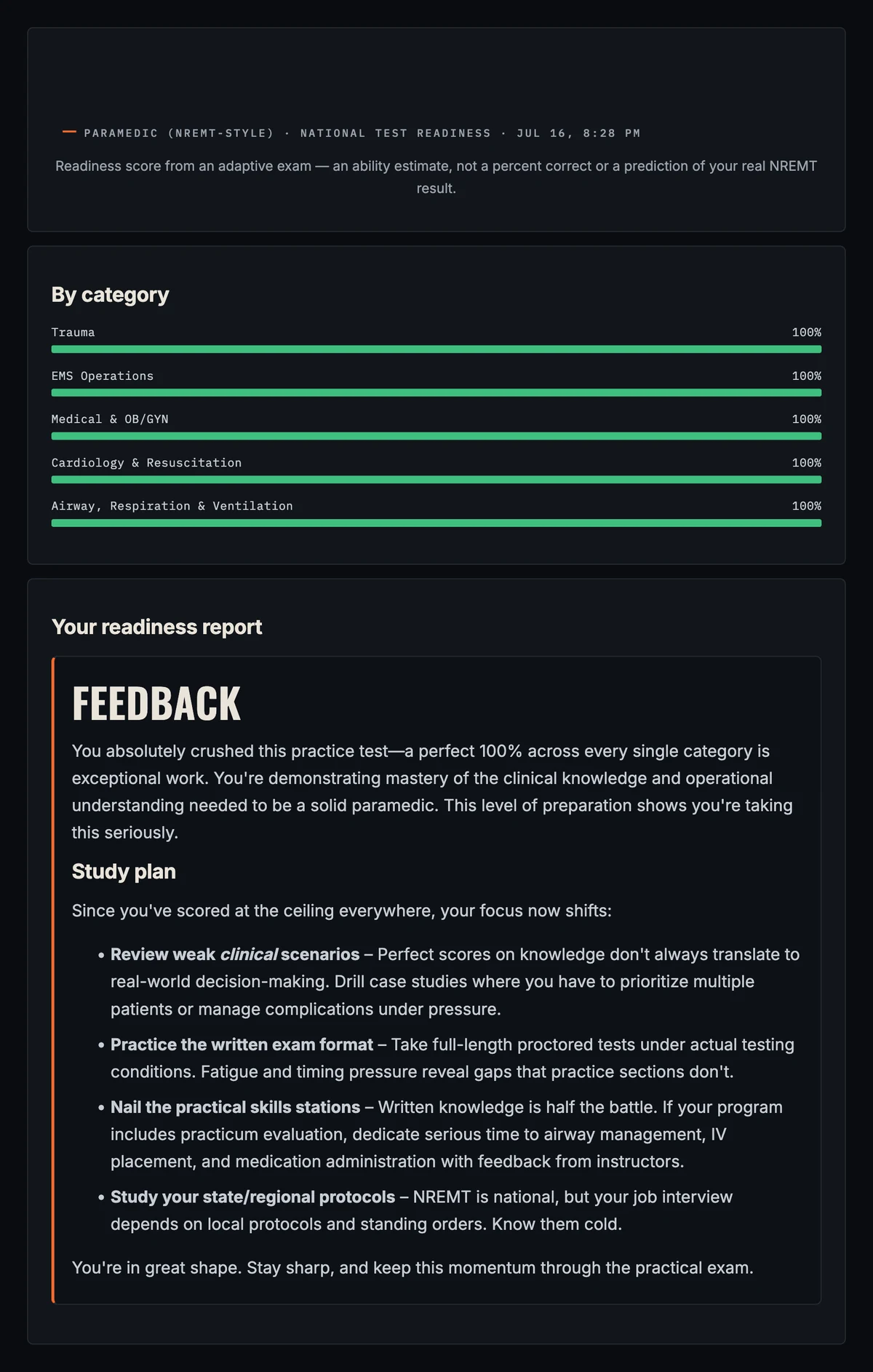
- Computer-adaptive exams at real length. The same shape as the Registry: EMT 70 to 120 questions on a 2-hour clock, Paramedic 110 to 150 on 3.5 hours, difficulty moving with your answers, drawn to the official test-plan weights.
- A question bank that teaches. Over 1,600 expert-written EMT and paramedic questions, every answer explained rather than just keyed, plus an AI tutor that writes unlimited fresh questions aimed at whatever you keep missing.
- Study Hall. Teaching lessons, printable field references, pharmacology flashcards, drug math drills, and an EKG rhythm tool that draws real tracings and walks you through reading them.
- Branching clinical scenarios. Patient cases that change with your decisions, with a preceptor debrief afterward. This is the clinical judgment the Registry actually tests and the part flashcards cannot reach.
- Radio report drills. MIST and SBAR handoffs, scored, because that is the other thing new medics get caught by.
Heading into paramedic school
A structured four-week on-ramp for an EMT with a start date. It begins with a 36-question diagnostic across the six domains programs expect you to already hold, then closes the gaps it finds.
- Week 1: Baseline and foundations. The diagnostic, then rebuild the anatomy and physiology everything else sits on. Free, no card.
- Week 2: The language and the math. Medical terminology and drug math until the conversions are automatic.
- Week 3: Cardiology and the EKG on-ramp. Walk into your first cardiology lecture already able to read a strip.
- Week 4: Assessment, airway and retest. Sharpen the EMT fundamentals, then take the diagnostic again and measure the movement.
Already failed the Registry
The NREMT stopped issuing a per-domain breakdown, so the report tells you how far you were from the standard and nothing about where. Retest Recovery runs a free baseline diagnostic drawn to the real blueprint weights, finds the domains that are actually weak, and builds a day-by-day plan around your retest date.
What it costs
The EMT readiness check and the paramedic school readiness check are free with no account. A free preview account opens the guides and a sample test. Everything above is in the 90-Day Hiring Season Pass, $59 once, which covers 90 days and does not auto-renew. Monthly is $24.99 after a 7-day free trial, and annual is $179 if you are on a longer school timeline.
30-day money-back guarantee. It is a satisfaction guarantee, not a promise about exam outcomes.